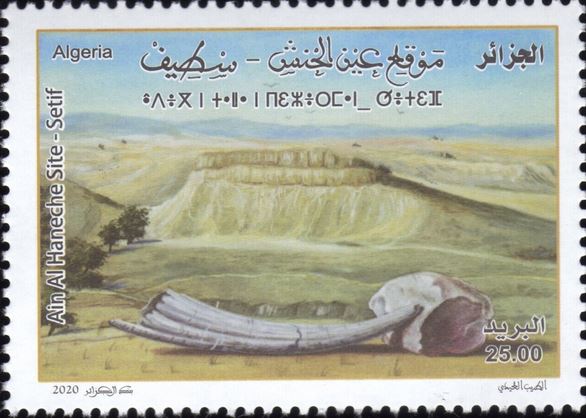
Site of Ain El Haneche – Sétif
Archaeologists have discovered lithic tools and animal bones at the Ain El Haneche site, dating back 2.4 million years. The site is located in the commune of Guelta Zerka, administrative district of El Eulma, wilaya of Sétif, at a distance of 35 km from the capital of the wilaya.
The site underwent several studies between 1931 and 1937, interrupted then resumed in 1947 by the French paleontologist Camille Arambourg, whose research made it possible to determine the existence of a Plio-Pleistocene deposit and who is behind the classification of this deposit of fossil bones (elephants, equines, cows, hippos, rhinoceroses, etc.) and cut pebbles consisting of subspheroid polyhedra and Oldowan spheroids that Lionel Balout called “circular spherical tools”, making the first discovery of very ancient archaeological remains at the same time as fossils belonging to savannah animals.
At the beginning of the 1990s, annual scientific research and excavations were planned with the aim of deciphering the enigmas of this site and distinguishing what links it to the existence of hominids; in this sense, a group of researchers, headed by the Quaternist and prehistorian Dr. Mohamed Sahnouni, undertook the study of objects from the lithic industry, exhibited at the Musée de l'Homme in Paris, coming from the excavations of Camille Arambourg, which were compared to the lithic tools discovered at Ain El Hanech and to those found in the sites of Olduvai in Tanzania (East Africa). Scientists consider the Olduvai site to be the oldest prehistoric archaeological site in the world, where fossil remains of Homo Habilis were discovered, which is why it has been called the “cradle of humanity”.
This discovery gave the site of Ain El Hanech a capital importance, relating to the migration of hominids from Africa to Europe and the ancient colonization of hominids of the North African region, reason why it is considered key to future studies of prehistory.
The site underwent several studies between 1931 and 1937, interrupted then resumed in 1947 by the French paleontologist Camille Arambourg, whose research made it possible to determine the existence of a Plio-Pleistocene deposit and who is behind the classification of this deposit of fossil bones (elephants, equines, cows, hippos, rhinoceroses, etc.) and cut pebbles consisting of subspheroid polyhedra and Oldowan spheroids that Lionel Balout called “circular spherical tools”, making the first discovery of very ancient archaeological remains at the same time as fossils belonging to savannah animals.
At the beginning of the 1990s, annual scientific research and excavations were planned with the aim of deciphering the enigmas of this site and distinguishing what links it to the existence of hominids; in this sense, a group of researchers, headed by the Quaternist and prehistorian Dr. Mohamed Sahnouni, undertook the study of objects from the lithic industry, exhibited at the Musée de l'Homme in Paris, coming from the excavations of Camille Arambourg, which were compared to the lithic tools discovered at Ain El Hanech and to those found in the sites of Olduvai in Tanzania (East Africa). Scientists consider the Olduvai site to be the oldest prehistoric archaeological site in the world, where fossil remains of Homo Habilis were discovered, which is why it has been called the “cradle of humanity”.
This discovery gave the site of Ain El Hanech a capital importance, relating to the migration of hominids from Africa to Europe and the ancient colonization of hominids of the North African region, reason why it is considered key to future studies of prehistory.