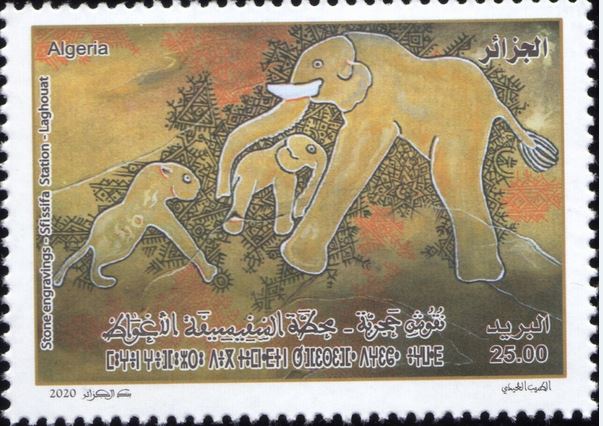
Rock art of the Sfissifa – El Ghicha – Laghouat station
Prehistoric man has long been preoccupied with the fauna and flora surrounding him, drawing as much benefit as possible and using them in his daily life. He hunted animals for food and clothing, but was also driven to do so by fear; all these aspects of his life were expressed by drawings and engravings which he applied to stone and which we encounter today in different sites across the country. One of these sites happens to be the station of Sfissifa, located in the commune of El Ghicha in Laghouat, which conceals a rich and diverse heritage, combining both rock art dating back to the Neolithic age and tourist landscapes attracting a significant number of visitors.
This location is located 10 km south of the capital of the commune of el Ghicha, on the side of the road. It has a single uncovered façade taking the form of a weathered rock formation that climatic hazards have begun to destroy and which is entirely exposed to the sun. As for the dimensions of this surface, they are 31.5m long and 7m high, representing numerous animals: an elephant, a tiger, a baby elephant accompanied by an adult elephant, two ostriches, a donkey, a bull and a snake.
The archaeological value of this site has been enhanced by the fact that it contains internationally renowned drawings, including the image of the female elephant protecting her calf and which was chosen as the emblem of the United Nations child protection organization UNICEF.
This drawing illustrates a moving baby elephant heading towards the left, protected by its mother. Located in the center of the facade and engraved with a wide and deep line, this drawing, 1.07m long and 1.85m wide, is well preserved.
This location is located 10 km south of the capital of the commune of el Ghicha, on the side of the road. It has a single uncovered façade taking the form of a weathered rock formation that climatic hazards have begun to destroy and which is entirely exposed to the sun. As for the dimensions of this surface, they are 31.5m long and 7m high, representing numerous animals: an elephant, a tiger, a baby elephant accompanied by an adult elephant, two ostriches, a donkey, a bull and a snake.
The archaeological value of this site has been enhanced by the fact that it contains internationally renowned drawings, including the image of the female elephant protecting her calf and which was chosen as the emblem of the United Nations child protection organization UNICEF.
This drawing illustrates a moving baby elephant heading towards the left, protected by its mother. Located in the center of the facade and engraved with a wide and deep line, this drawing, 1.07m long and 1.85m wide, is well preserved.