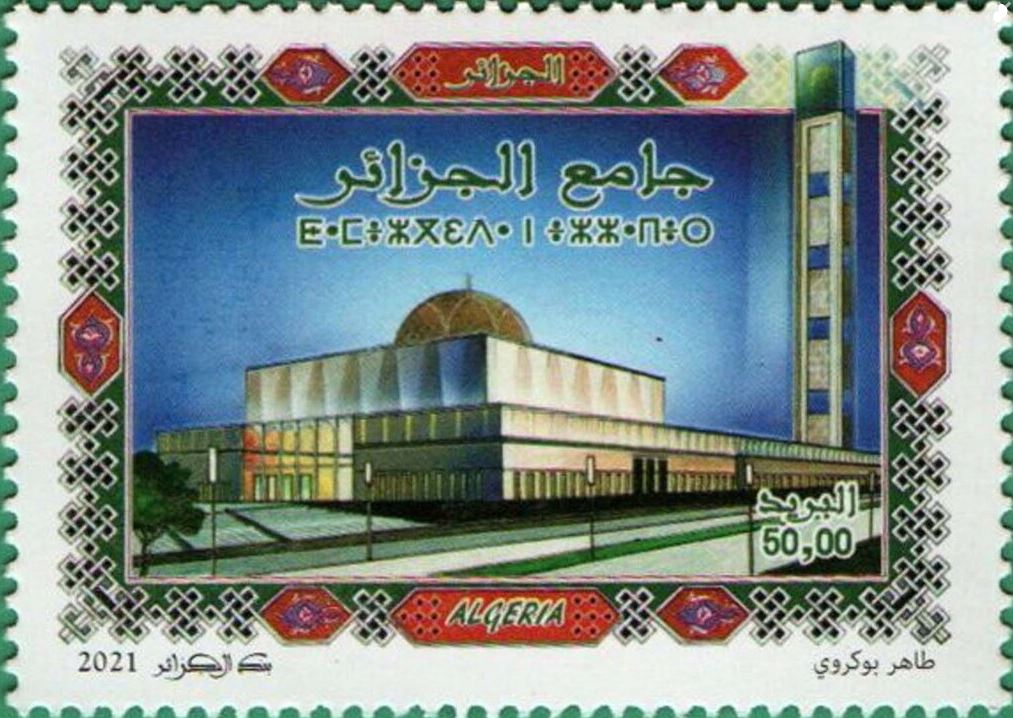
Djamaa El Djazaïr
Djamaa El Djazaïr is part of a vast development program of a religious, cultural, scientific and tourist nature. This complex will have a dual vocation as a place of conviviality and gathering of the faithful for prayer but also as an attractive center for researchers, historians, artists, craftsmen, students as well as for tourists and the general public.
Djamaâ El Djazaïr will symbolize an important stage in the history of the country and will be the mosque of independence and the recovery of national sovereignty like Djamaâ ElKebir built in the 11th century by the Almoravids and Djamaâ Djedid built in the 17th century during the Ottoman period. This monument, through its architectural signature, aims to illustrate an updated interpretation inspired by Maghreb and Andalusian Islamic art.
In this context, the ornamentation of Djamaâ el Djazaïr must reflect national identity, via a judicious balance between authenticity and modernity.
Djamaa El Djazaïr is an Islamic cultural center, located in Mohammedia - Algiers East, the largest mosque in Algeria and Africa and the third largest mosque in the world in terms of total area after the two mosques Masjid al-Haram of Mecca and Masjid al-Nabawi of Medina…
The mosque has twelve independent buildings, with an area of 30 hectares built on more than 400,000 m², includes a prayer room with an area of approximately 22,000 m², which can accommodate more than 36,000 worshipers and an arena occupying 44,000 m². The parking lot can accommodate up to 4,000 cars with an area of 70,000 m². Djamaa El Djazaïr also contains a dome 50 m in diameter and 72 m high, located in the middle of the prayer room, where the functional and aesthetic aspects combine. Composed of an interior and exterior cover, it constitutes a modern reading of the traditional dome “Muqarnas”, inspired by the Islamic architecture of the Almoravids from the interior, is decorated with decorative mashrabia from the exterior, which accentuates the internal face of the dome.
Djamaa El Djazaïr has a minaret which reflects the Maghreb style and also serves as a lighthouse, with a height of 265 m and 43 floors, two basements and a ground floor which will make it the largest in the world, the museum of Islamic art and history spread over 15 floors is equipped with didactic means helping to discover the art and history of Islam in Algeria through the Last 15 centuries.
The Djamaâ el Djazaïr mosque will also have a Dar El Koran, libraries, an Islamic cultural center in addition to green spaces.
Access to the mosque is easy from the side of the highway leading to Algiers International Airport, not far from the tram stop, in front of the Bay of Algiers, which can be used as a means of maritime transport to the mosque via the bridge that will connect it to the destination.
Djamaâ El Djazaïr will symbolize an important stage in the history of the country and will be the mosque of independence and the recovery of national sovereignty like Djamaâ ElKebir built in the 11th century by the Almoravids and Djamaâ Djedid built in the 17th century during the Ottoman period. This monument, through its architectural signature, aims to illustrate an updated interpretation inspired by Maghreb and Andalusian Islamic art.
In this context, the ornamentation of Djamaâ el Djazaïr must reflect national identity, via a judicious balance between authenticity and modernity.
Djamaa El Djazaïr is an Islamic cultural center, located in Mohammedia - Algiers East, the largest mosque in Algeria and Africa and the third largest mosque in the world in terms of total area after the two mosques Masjid al-Haram of Mecca and Masjid al-Nabawi of Medina…
The mosque has twelve independent buildings, with an area of 30 hectares built on more than 400,000 m², includes a prayer room with an area of approximately 22,000 m², which can accommodate more than 36,000 worshipers and an arena occupying 44,000 m². The parking lot can accommodate up to 4,000 cars with an area of 70,000 m². Djamaa El Djazaïr also contains a dome 50 m in diameter and 72 m high, located in the middle of the prayer room, where the functional and aesthetic aspects combine. Composed of an interior and exterior cover, it constitutes a modern reading of the traditional dome “Muqarnas”, inspired by the Islamic architecture of the Almoravids from the interior, is decorated with decorative mashrabia from the exterior, which accentuates the internal face of the dome.
Djamaa El Djazaïr has a minaret which reflects the Maghreb style and also serves as a lighthouse, with a height of 265 m and 43 floors, two basements and a ground floor which will make it the largest in the world, the museum of Islamic art and history spread over 15 floors is equipped with didactic means helping to discover the art and history of Islam in Algeria through the Last 15 centuries.
The Djamaâ el Djazaïr mosque will also have a Dar El Koran, libraries, an Islamic cultural center in addition to green spaces.
Access to the mosque is easy from the side of the highway leading to Algiers International Airport, not far from the tram stop, in front of the Bay of Algiers, which can be used as a means of maritime transport to the mosque via the bridge that will connect it to the destination.