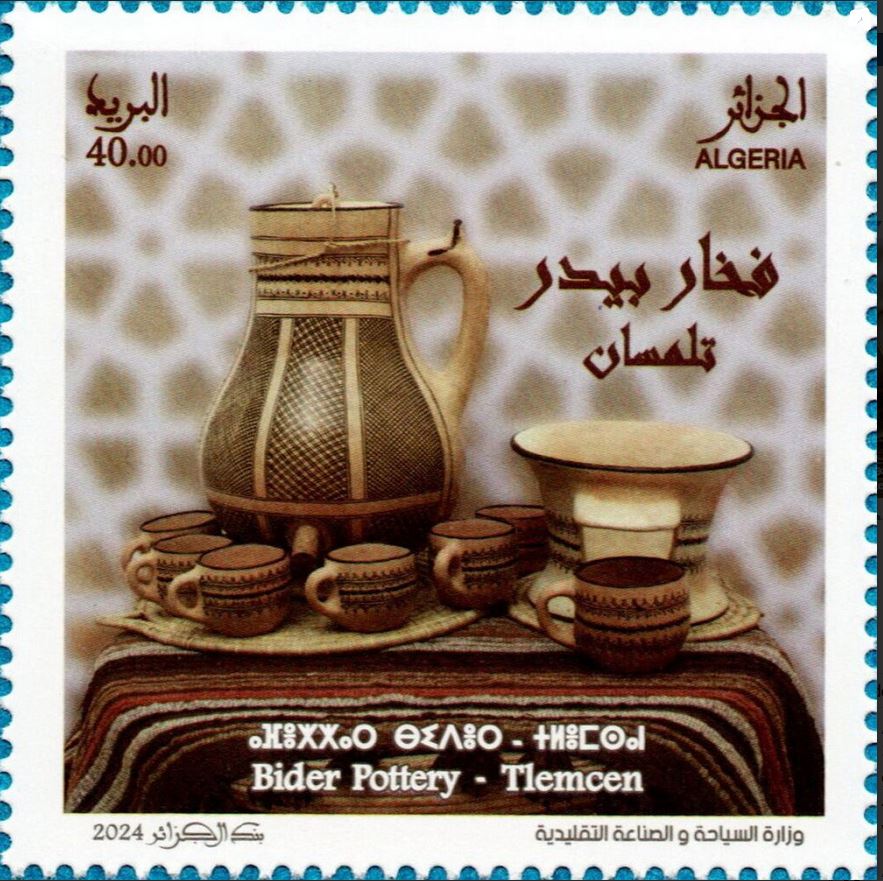
Bider pottery, Tlemcen
Pottery is one of the oldest crafts practiced by man since ancient times. Algeria is distinguished by this craftsmanship throughout its territory, particularly in the wilaya of Tlemcen, which stands out for its unique pottery in the region of 'Bider', one of the villages within the commune of M'Sirda Fouaga. This village is famous for the production of traditional pottery, which is named after the region itself. This craft has been passed down from generation to generation for centuries, and despite this, the locals have retained the same patterns used for decoration.
These potteries are made by the women of the region, and are open to many interpretations. Through them, these artisans tell stories and write History without words. It is a language that matter speaks with a particular technique transmitted over time, which has become a characteristic of their daily life.
The inhabitants of the village of 'Bider' take care to preserve traditional pottery as a heritage of this region, particularly through the shapes and colors they give to clay objects, considered the best in the country. There are two types of clay: the first, called 'Medri - river clay', comes from streams, rivers and plateaus; the second is 'stone clay', extracted from the mountains in the form of rocks which are then crushed to be kneaded. Both types of clay come in several colors, such as green, white, red, black, and yellow. Craftsmen generally distinguish river clay from stone clay: the former is fired at a temperature of 950 to 1150 degrees Celsius, while the latter is fired at over 1200 degrees.
The pottery is dried in the open air and in the sun, then fired with controlled ventilation to obtain a red or black color depending on the oxidation of the metals present.
Manufacturing process for this pottery:
• It is based on the raw material, which is mixed with sand and water in precise proportions, then kneaded on foot to extract the air. The objects are shaped by hand on a wooden board and a flat stone, without the use of machines in the creation of these pieces of art and domestic utensils.
• They are then cooked in a traditional wood-fired oven. For decoration, an herb collected from the forest called 'Dharou - Pistachio mastic tree' is used. Once dried, it is pounded, mixed with water, filtered, and its extract is used as a natural dye to paint designs on clay objects after they come out of the kiln. The decoration is done with 'El Rakam', a fine tool made from clay and goat hair.
These potteries are made by the women of the region, and are open to many interpretations. Through them, these artisans tell stories and write History without words. It is a language that matter speaks with a particular technique transmitted over time, which has become a characteristic of their daily life.
The inhabitants of the village of 'Bider' take care to preserve traditional pottery as a heritage of this region, particularly through the shapes and colors they give to clay objects, considered the best in the country. There are two types of clay: the first, called 'Medri - river clay', comes from streams, rivers and plateaus; the second is 'stone clay', extracted from the mountains in the form of rocks which are then crushed to be kneaded. Both types of clay come in several colors, such as green, white, red, black, and yellow. Craftsmen generally distinguish river clay from stone clay: the former is fired at a temperature of 950 to 1150 degrees Celsius, while the latter is fired at over 1200 degrees.
The pottery is dried in the open air and in the sun, then fired with controlled ventilation to obtain a red or black color depending on the oxidation of the metals present.
Manufacturing process for this pottery:
• It is based on the raw material, which is mixed with sand and water in precise proportions, then kneaded on foot to extract the air. The objects are shaped by hand on a wooden board and a flat stone, without the use of machines in the creation of these pieces of art and domestic utensils.
• They are then cooked in a traditional wood-fired oven. For decoration, an herb collected from the forest called 'Dharou - Pistachio mastic tree' is used. Once dried, it is pounded, mixed with water, filtered, and its extract is used as a natural dye to paint designs on clay objects after they come out of the kiln. The decoration is done with 'El Rakam', a fine tool made from clay and goat hair.