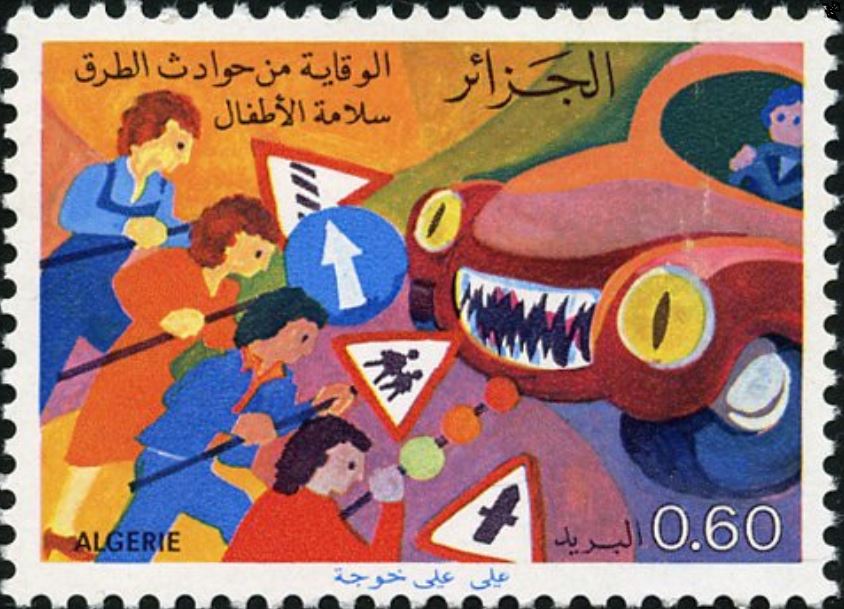
Road Prevention
In Algeria, thousands of children aged over 6 go to school every day and are rarely accompanied by adults. They move around alone and turn the streets into playgrounds.
Generally, adults do not demonstrate a very keen sense of responsibility. Most often they seem to have confidence in their children. They send them shopping even if the streets to cross are dangerous.
Let us also recognize that in our country with fairly high traffic, the number of young victims (minors aged under 15) is 4,837, of which 258 died during 1977. The percentage of these young victims represents 40% of the total number of people killed and injured during the same year.
In the chain of causes and circumstances which precede any traffic accident, three factors are generally invoked: the man, the vehicle, the road. But before setting our sights on these factors, one phenomenon remains to be discussed and highlighted, that of the road environment which was not designed for children.
Indeed, just like any moral or social environment in which the child is immersed, the road environment must create, from a very young age, the conditional reflexes necessary for the child's development on the street with a minimum of risk. This is why it should be emphasized that the road environment currently in force remains distant, indecipherable, even foreign to the child's world as it was made by and for adults.
There is reason to adapt and lower ourselves to the level of the categories of the child's understanding to first interest him better and then warn him of the dangers that await him. In this sense, the child is more permeable, more open than the adult to this type of road education.
For example, we can cite cases where the meaning of road symbols is not obvious to young children; the green light gives passage to the child when he is on a bicycle or in his father's car. But the green light does not give the right of passage to the child pedestrian and making this understood to a young person aged 6 to 7 and even older remains very difficult. This remains valid, especially when we consider that the child's development does not yet meet all the conditions for physiological and psychomotor maturation which are often the cause of dramatic accidents.
Among the physiological obstacles, it is well known that a child has poor lateral vision: he has difficulty seeing a vehicle approaching and has difficulty locating the origin of the senses. On a psychological level, it’s not simple either. The child has unidirectional attention: he thinks about one thing and not another. This is how we can explain this terrible accident where the child leaving a school or walking on a sidewalk sees his father, his mother or his friend. He then no longer thinks about cars and rushes towards the person he sees.
And then, there are the multitude of bad examples given by adults in traffic, which is almost catastrophic given the importance of the process of imitation in education. Given this data, a question arises: whose fault is it?
Generally, adults do not demonstrate a very keen sense of responsibility. Most often they seem to have confidence in their children. They send them shopping even if the streets to cross are dangerous.
Let us also recognize that in our country with fairly high traffic, the number of young victims (minors aged under 15) is 4,837, of which 258 died during 1977. The percentage of these young victims represents 40% of the total number of people killed and injured during the same year.
In the chain of causes and circumstances which precede any traffic accident, three factors are generally invoked: the man, the vehicle, the road. But before setting our sights on these factors, one phenomenon remains to be discussed and highlighted, that of the road environment which was not designed for children.
Indeed, just like any moral or social environment in which the child is immersed, the road environment must create, from a very young age, the conditional reflexes necessary for the child's development on the street with a minimum of risk. This is why it should be emphasized that the road environment currently in force remains distant, indecipherable, even foreign to the child's world as it was made by and for adults.
There is reason to adapt and lower ourselves to the level of the categories of the child's understanding to first interest him better and then warn him of the dangers that await him. In this sense, the child is more permeable, more open than the adult to this type of road education.
For example, we can cite cases where the meaning of road symbols is not obvious to young children; the green light gives passage to the child when he is on a bicycle or in his father's car. But the green light does not give the right of passage to the child pedestrian and making this understood to a young person aged 6 to 7 and even older remains very difficult. This remains valid, especially when we consider that the child's development does not yet meet all the conditions for physiological and psychomotor maturation which are often the cause of dramatic accidents.
Among the physiological obstacles, it is well known that a child has poor lateral vision: he has difficulty seeing a vehicle approaching and has difficulty locating the origin of the senses. On a psychological level, it’s not simple either. The child has unidirectional attention: he thinks about one thing and not another. This is how we can explain this terrible accident where the child leaving a school or walking on a sidewalk sees his father, his mother or his friend. He then no longer thinks about cars and rushes towards the person he sees.
And then, there are the multitude of bad examples given by adults in traffic, which is almost catastrophic given the importance of the process of imitation in education. Given this data, a question arises: whose fault is it?