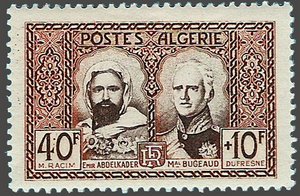
Emir Abd El Kader and Marshal Bugeaud
Inauguration of the monument of Emir Abd El Kader in Cacherou
Cacherou (Sidi Kada) is a Center created in 1874 in the department of Oran district of Mascara
October 15, 1949: The Governor-General of Algeria, Naegelen, inaugurates, on the Cacherou plateau, a monument in memory of the Emir Abd El Kader, on the stele is inscribed this sentence pronounced by the Emir:
“If Muslims and Christians would listen to me, I would put an end to their differences and they would become brothers inside and out.”
Emir AbdelKader (1808 - 1883)
Born in 1808 in Guetna de Oued El-Hammam (West of Mascara) in a family of the Hachem tribe established in the Eghris plain. Abdelkader son of Mahieddine received a solid education. Very early introduced to modern sciences, he studied in Arzew and Oran, and made his first trip to Tunisia, Egypt then Mecca and Medin in 1826.
On November 21, 1832, the tribes gathered in Ersebia proclaimed him Emir at the age of 24.
A highly intelligent military strategist, statesman gifted with an innate sense of organization and well-read in a vast scientific and religious culture, Emir Abdelkader left an indelible mark on the history of Algeria.
A military strategist, he launched the call for Jihad in 1830 and led the resistance from Mascara, his capital. He defeated the French troops and in 1834 forced General
Desmichels to sign a treaty which recognized his authority. After the colonial offensive against Mascara and Tlemcen in 1836, he moved his capital to Tagdemt. A year later, having strengthened his positions, he concluded the Treaty of Tafna with Marshal Bugeaud (May 30, 1837) and set about founding a State capable of achieving the unity of the Nation and driving out the invader. He brought together under his banner the tribes of Oranie, the South, the East and Kabylie who placed themselves under the direction of his State which now controlled two thirds of Algeria.
A statesman, he organized the territory of the Khalifas (Mascara, Médéa, Miliana, Tlemcen, Zïbans, Medjana) with 59,000 fighters. During this period, he launched a vast program of urban, economic and administrative development. mints the currency and opens numerous industrial workshops including arms factories.
Faced with the enemy's push, served by colossal means, the Emir conceded Médéa, Tagdemt, Saïda and Tlemcen and, despite some breakthroughs in Mitidja and Chlef, he retreated towards Dahra. However, he resumed the offensive in Ouarsenis, in Kabylia and in the South (Djebel Amour), thwarted in his plans by the Sultan of Morocco who launched his troops against him.
Imprisoned at Fort Lamarque in Toulon until April 1848. in Pau until November 1848, and in Amboise until October 1852, he left France in 1852. He died in Damascus in 1883 after 17 years of combat and 36 years of exile.
A man of great culture, he wrote numerous mystical poems as well as the famous “Rissala” or “Reminder to the intelligent, advice to the indifferent”, a philosophical, economic, historical and ethnographic reflection of great interest.
His mystical writings were published in Algiers under the generic title “El-Mawaqïf”.
Marshal BUGEAUD (1958 - 1960)
Bugeaud, Marquis de la Piconnerie, was born in 1784. He entered the army modestly, a simple corporal in 1805; he was made Lieutenant by Napoleon on December 21, 1806. It was during the Spanish campaign that he obtained his fourth stripe. After the troubled period of the Restoration, he was finally dismissed by the second restoration and returned to his lands.
He resumed activity during the days of 1830. Elected deputy in 1831, he nevertheless returned to service in the 56th line. In 1836, he left for Algeria to stabilize the situation and won the victory of Sikkak over Abd-El-Kader.
Appointed Governor General of Algeria in December 1840, he embarked on the colonization of Algeria. Raised to the dignity of Marshal of France, in 1844 he won a victory over the Moroccans and was made Duke of Isly.
In 1847, Kabylia and Abd-El-Kader were subjugated, but Bugeaud had to bow to the Revolution of 1848. Appointed by Napoleon III commander of the Army of the Alps, he died of cholera in 1849.
Cacherou (Sidi Kada) is a Center created in 1874 in the department of Oran district of Mascara
October 15, 1949: The Governor-General of Algeria, Naegelen, inaugurates, on the Cacherou plateau, a monument in memory of the Emir Abd El Kader, on the stele is inscribed this sentence pronounced by the Emir:
“If Muslims and Christians would listen to me, I would put an end to their differences and they would become brothers inside and out.”
Emir AbdelKader (1808 - 1883)
Born in 1808 in Guetna de Oued El-Hammam (West of Mascara) in a family of the Hachem tribe established in the Eghris plain. Abdelkader son of Mahieddine received a solid education. Very early introduced to modern sciences, he studied in Arzew and Oran, and made his first trip to Tunisia, Egypt then Mecca and Medin in 1826.
On November 21, 1832, the tribes gathered in Ersebia proclaimed him Emir at the age of 24.
A highly intelligent military strategist, statesman gifted with an innate sense of organization and well-read in a vast scientific and religious culture, Emir Abdelkader left an indelible mark on the history of Algeria.
A military strategist, he launched the call for Jihad in 1830 and led the resistance from Mascara, his capital. He defeated the French troops and in 1834 forced General
Desmichels to sign a treaty which recognized his authority. After the colonial offensive against Mascara and Tlemcen in 1836, he moved his capital to Tagdemt. A year later, having strengthened his positions, he concluded the Treaty of Tafna with Marshal Bugeaud (May 30, 1837) and set about founding a State capable of achieving the unity of the Nation and driving out the invader. He brought together under his banner the tribes of Oranie, the South, the East and Kabylie who placed themselves under the direction of his State which now controlled two thirds of Algeria.
A statesman, he organized the territory of the Khalifas (Mascara, Médéa, Miliana, Tlemcen, Zïbans, Medjana) with 59,000 fighters. During this period, he launched a vast program of urban, economic and administrative development. mints the currency and opens numerous industrial workshops including arms factories.
Faced with the enemy's push, served by colossal means, the Emir conceded Médéa, Tagdemt, Saïda and Tlemcen and, despite some breakthroughs in Mitidja and Chlef, he retreated towards Dahra. However, he resumed the offensive in Ouarsenis, in Kabylia and in the South (Djebel Amour), thwarted in his plans by the Sultan of Morocco who launched his troops against him.
Imprisoned at Fort Lamarque in Toulon until April 1848. in Pau until November 1848, and in Amboise until October 1852, he left France in 1852. He died in Damascus in 1883 after 17 years of combat and 36 years of exile.
A man of great culture, he wrote numerous mystical poems as well as the famous “Rissala” or “Reminder to the intelligent, advice to the indifferent”, a philosophical, economic, historical and ethnographic reflection of great interest.
His mystical writings were published in Algiers under the generic title “El-Mawaqïf”.
Marshal BUGEAUD (1958 - 1960)
Bugeaud, Marquis de la Piconnerie, was born in 1784. He entered the army modestly, a simple corporal in 1805; he was made Lieutenant by Napoleon on December 21, 1806. It was during the Spanish campaign that he obtained his fourth stripe. After the troubled period of the Restoration, he was finally dismissed by the second restoration and returned to his lands.
He resumed activity during the days of 1830. Elected deputy in 1831, he nevertheless returned to service in the 56th line. In 1836, he left for Algeria to stabilize the situation and won the victory of Sikkak over Abd-El-Kader.
Appointed Governor General of Algeria in December 1840, he embarked on the colonization of Algeria. Raised to the dignity of Marshal of France, in 1844 he won a victory over the Moroccans and was made Duke of Isly.
In 1847, Kabylia and Abd-El-Kader were subjugated, but Bugeaud had to bow to the Revolution of 1848. Appointed by Napoleon III commander of the Army of the Alps, he died of cholera in 1849.