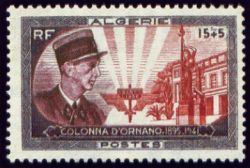
Effigy of Colonel Colonna d’Ornano
Jean Colonna d'Ornano was born on April 5, 1895 in Algiers.
He had a brilliant secondary education at the Lycée d'Algiers.
Enlisted on September 24, 1914 with the 1st Spahis in Medeah, he soon became a sergeant in the 6th Battalion of Senegalese Tirailleurs in Blidah with which he began the war against Germany. Two citations were awarded to him in October 1916 and April 1917.
Appointed second lieutenant in March 1918, he was cited twice again in June and October of the same year.
The war ended, Jean Colonna d'Ornano left for Syria where he distinguished himself again. Then his career continued in Senegal, Mauritania, the Sahara, and Sudan, where he proved to be an excellent administrator.
From 1932 to 1936, he served in Morocco, officer of indigenous affairs and above all, commander of a 'harka' of partisans on whom he imposed himself by his physical vigor, by his words, by his energy and also, by his magnificent performance under fire.
In March 1938, battalion chief, command of the Borkou-Ennedi-Tibesti circle was entrusted to him. It was therefore in equatorial Africa that the war surprised him.
On May 6, 1940, well before Italy's entry into the war, he received the announcement of the irruption of an Italian motorized column in the French zone.
The Italians confirm their claims to French possessions in Africa, angering officials of the colonial army. Also, from the armistice of June 1940, Commander d'Ornano joined Free France, taking with him many officers and soldiers who, for a long time, had given him their trust and esteem. On August 18, 1940 he 'deserted' and joined Colonel de Larminat in Léopoldville before reaching Fort-Lamy with René Pleven and participating in the rallying of Chad to Free France on August 26.
Promoted to lieutenant colonel, Jean Colonna d'Ornano became, at Fort-Lamy, the deputy of Colonel Marchand who commanded the Senegalese Tirailleurs du Tchad Regiment (RTST).
In December 1940, coming from Cameroon, Colonel Leclerc went to Chad on the orders of General de Gaulle as military commander of the territories of Chad and to carry out the war in Libya. Immediately, Lieutenant-Colonel Colonna d'Ornano brought to Colonel Leclerc, for the preparation of this offensive, his full support and, above all, all his experience as a wise Saharan.
From January 2, 1941, he gave his instructions for the attack on Mourzouk. Colonna d'Ornano claims and obtains the honor of being the first to attack the Italian enemy. It was during this fight that Jean Colonna d'Ornano met a glorious end on January 11, 1941.
His body was to rest at Mourzouk until the departure of the French troops. His remains were first brought back to Algiers (December 10, 1956) then from there to Corsica where they arrived on December 20, 1956, aboard the escort Guichen, to be buried in Ajaccio.
He had a brilliant secondary education at the Lycée d'Algiers.
Enlisted on September 24, 1914 with the 1st Spahis in Medeah, he soon became a sergeant in the 6th Battalion of Senegalese Tirailleurs in Blidah with which he began the war against Germany. Two citations were awarded to him in October 1916 and April 1917.
Appointed second lieutenant in March 1918, he was cited twice again in June and October of the same year.
The war ended, Jean Colonna d'Ornano left for Syria where he distinguished himself again. Then his career continued in Senegal, Mauritania, the Sahara, and Sudan, where he proved to be an excellent administrator.
From 1932 to 1936, he served in Morocco, officer of indigenous affairs and above all, commander of a 'harka' of partisans on whom he imposed himself by his physical vigor, by his words, by his energy and also, by his magnificent performance under fire.
In March 1938, battalion chief, command of the Borkou-Ennedi-Tibesti circle was entrusted to him. It was therefore in equatorial Africa that the war surprised him.
On May 6, 1940, well before Italy's entry into the war, he received the announcement of the irruption of an Italian motorized column in the French zone.
The Italians confirm their claims to French possessions in Africa, angering officials of the colonial army. Also, from the armistice of June 1940, Commander d'Ornano joined Free France, taking with him many officers and soldiers who, for a long time, had given him their trust and esteem. On August 18, 1940 he 'deserted' and joined Colonel de Larminat in Léopoldville before reaching Fort-Lamy with René Pleven and participating in the rallying of Chad to Free France on August 26.
Promoted to lieutenant colonel, Jean Colonna d'Ornano became, at Fort-Lamy, the deputy of Colonel Marchand who commanded the Senegalese Tirailleurs du Tchad Regiment (RTST).
In December 1940, coming from Cameroon, Colonel Leclerc went to Chad on the orders of General de Gaulle as military commander of the territories of Chad and to carry out the war in Libya. Immediately, Lieutenant-Colonel Colonna d'Ornano brought to Colonel Leclerc, for the preparation of this offensive, his full support and, above all, all his experience as a wise Saharan.
From January 2, 1941, he gave his instructions for the attack on Mourzouk. Colonna d'Ornano claims and obtains the honor of being the first to attack the Italian enemy. It was during this fight that Jean Colonna d'Ornano met a glorious end on January 11, 1941.
His body was to rest at Mourzouk until the departure of the French troops. His remains were first brought back to Algiers (December 10, 1956) then from there to Corsica where they arrived on December 20, 1956, aboard the escort Guichen, to be buried in Ajaccio.