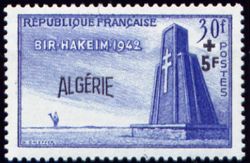
10th Anniversary of the Battle of Bir Hakeim in Libya
Battle of Bir Hakeim in Libya.
At the end of May 1942, the first brigade of the Free French Forces occupied the south of the British 8th Army in Libya facing the German-Italian Axis Forces. A support point on the extreme left of the device, this position is of considerable importance, because it is able to prevent any encirclement maneuver from the south of the Allied Forces, in disorderly retreat, after the defeat and fall of Tobruk which opens the way to Cairo for German tanks.
On May 27, 1942, the position of Bir Hakeim, attacked by the Italian armored division 'Ariete', sustained a fierce fight carried out to the interior of the strong point. The enemy, pushed back, left forty tanks on the ground.
From June 1 to 10, the position, methodically harassed, was completely surrounded by German and Italian forces, in overwhelming numerical superiority. General Rommel, commanding the enemy forces, is trying to break this barrier. To the ultimatum demanding a surrender, General Kœnig, commanding the French brigade, replied: 'We are not here to surrender.'
Despite the most violent artillery fire and aerial bombardments, the Brigade repels all attacks, does not give up an inch of ground, and inflicts high losses on the enemy.
The incredible audacity of a group of Train volunteers succeeded, at night, in bringing a convoy of thirty trucks into the position. On June 10, however, all resources of water, food and ammunition were on the verge of being exhausted. The garrison receives the order to withdraw from the Commander of the 8th British Army. During the night of the 10th to the 11th, it forced its way through enemy lines and minefields, bringing back its wounded and the equipment still usable.
Through its prolonged resistance beyond all hope and whose worldwide impact was immense, the 1st Free French Brigade allowed the 8th British Army to break free and find the time necessary to redress the situation at El Alamein. To the French, then under German oppression, it confirmed their faith in their destiny and in victory. The internal Resistance, that of Jean Moulin and Christian Pineau, joined Free France to form a single fighting France.
The Cemetery, erected on the very site of the fighting, has been maintained 'In Memoriam'. A track leads there, marked with Croix de Lorraine, from El Adem.
Due to its isolation, the 182 bodies it contained were transferred to this place, where also rest the first four French soldiers who fell in Cyrenaica, on January 21, 1941, and the six dead from the Koufra operation led by General Leclerc.
At the end of May 1942, the first brigade of the Free French Forces occupied the south of the British 8th Army in Libya facing the German-Italian Axis Forces. A support point on the extreme left of the device, this position is of considerable importance, because it is able to prevent any encirclement maneuver from the south of the Allied Forces, in disorderly retreat, after the defeat and fall of Tobruk which opens the way to Cairo for German tanks.
On May 27, 1942, the position of Bir Hakeim, attacked by the Italian armored division 'Ariete', sustained a fierce fight carried out to the interior of the strong point. The enemy, pushed back, left forty tanks on the ground.
From June 1 to 10, the position, methodically harassed, was completely surrounded by German and Italian forces, in overwhelming numerical superiority. General Rommel, commanding the enemy forces, is trying to break this barrier. To the ultimatum demanding a surrender, General Kœnig, commanding the French brigade, replied: 'We are not here to surrender.'
Despite the most violent artillery fire and aerial bombardments, the Brigade repels all attacks, does not give up an inch of ground, and inflicts high losses on the enemy.
The incredible audacity of a group of Train volunteers succeeded, at night, in bringing a convoy of thirty trucks into the position. On June 10, however, all resources of water, food and ammunition were on the verge of being exhausted. The garrison receives the order to withdraw from the Commander of the 8th British Army. During the night of the 10th to the 11th, it forced its way through enemy lines and minefields, bringing back its wounded and the equipment still usable.
Through its prolonged resistance beyond all hope and whose worldwide impact was immense, the 1st Free French Brigade allowed the 8th British Army to break free and find the time necessary to redress the situation at El Alamein. To the French, then under German oppression, it confirmed their faith in their destiny and in victory. The internal Resistance, that of Jean Moulin and Christian Pineau, joined Free France to form a single fighting France.
The Cemetery, erected on the very site of the fighting, has been maintained 'In Memoriam'. A track leads there, marked with Croix de Lorraine, from El Adem.
Due to its isolation, the 182 bodies it contained were transferred to this place, where also rest the first four French soldiers who fell in Cyrenaica, on January 21, 1941, and the six dead from the Koufra operation led by General Leclerc.