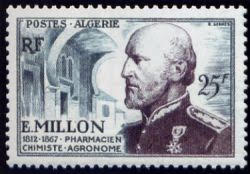
Effigy of Dr. E. Million
Dr. Eugène Millon (1812-1867), In honor of the Military Health Corps
Chief Pharmacist of the Algerian Army,
Chemist, Agronomist, Professor.
Eugène Millon, born in Châlons-sur-Marne in 1812, is the most notable figure among the pharmacists of the African Army. In the field of food, he was the worthy successor of Parmentier, and the precursor of Balland. After a stay of several months in Algeria, in 1835, during which he participated in the fight against the cholera epidemic, he was qualified as a doctor (August 1836). But, attracted by chemistry, he turned towards pharmacy at the end of 1837. After various positions in the provinces, on March 19, 1841, following a brilliant competition, he became professor of chemistry at Val-de-Grâce. He had already distinguished himself through valuable scientific work when, suddenly, in 1847, he was sent in disgrace to the military training hospital in Lille. Angered by such a measure, he devoted himself to the study of agricultural, economic and social questions, and became an ardent publicist. His liberal opinions worried the government, he was transferred to Algiers in 1850. He continued his research on wheat begun in Lille. He envisaged the creation of an Algerian institute, intended to replace the routine and empirical practice of the Arabs, both in agriculture and in certain artisanal works, with the benefits of French technique.
This institute never saw the light of day But, an unparalleled scholar, with a brilliant and brilliant mind, Millon was the guide and advisor listened to and disinterested by everyone, from the European and the Muslim, from the last of the fellahs or artisans to governors Pélissier and Vaillant.
Million left an indelible mark on Algerian agriculture and industry. All the resources, all the productions of the country caught his attention: he improved the conditions of detention of grains which were spoiling in the humid and permeable Arab silos; he perfected indigenous milling methods; he developed winemaking techniques; he studied the quality of Algerian milk as well as the conditions of their production and sale; he analyzed numerous drinking or mineral waters; he became interested in the production and trade of leeches; various questions of general hygiene; he endeavored to develop the cultivation of aromatic plants and to obtain better extraction of perfumes.
Near the Dey hospital, on the road to Bouzaréah, in a picturesque ravine that he called the Frais Vallon, he had established a small farm where he spent his rare moments of leisure. In 1865, when he retired, he left for Paris to resume the chemical work that he had had to interrupt. He was to die there in 1867, at the age of fifty-five. When publishing the results of the analysis of the cold ferruginous water of Frais Vallon, which gushed near his farm, he expressed bold ideas on the possibility of using the therapeutic properties of Algerian mineral waters, already known to the Romans but fallen into oblivion. Millon was not just the wise chemist that many know him to be. He was also an eminent economist, a skilled technician and a convinced apostle of social reforms. During the fifteen years spent in Algeria, he made an immense contribution to the economic and social work of France in this country.
Chief Pharmacist of the Algerian Army,
Chemist, Agronomist, Professor.
Eugène Millon, born in Châlons-sur-Marne in 1812, is the most notable figure among the pharmacists of the African Army. In the field of food, he was the worthy successor of Parmentier, and the precursor of Balland. After a stay of several months in Algeria, in 1835, during which he participated in the fight against the cholera epidemic, he was qualified as a doctor (August 1836). But, attracted by chemistry, he turned towards pharmacy at the end of 1837. After various positions in the provinces, on March 19, 1841, following a brilliant competition, he became professor of chemistry at Val-de-Grâce. He had already distinguished himself through valuable scientific work when, suddenly, in 1847, he was sent in disgrace to the military training hospital in Lille. Angered by such a measure, he devoted himself to the study of agricultural, economic and social questions, and became an ardent publicist. His liberal opinions worried the government, he was transferred to Algiers in 1850. He continued his research on wheat begun in Lille. He envisaged the creation of an Algerian institute, intended to replace the routine and empirical practice of the Arabs, both in agriculture and in certain artisanal works, with the benefits of French technique.
This institute never saw the light of day But, an unparalleled scholar, with a brilliant and brilliant mind, Millon was the guide and advisor listened to and disinterested by everyone, from the European and the Muslim, from the last of the fellahs or artisans to governors Pélissier and Vaillant.
Million left an indelible mark on Algerian agriculture and industry. All the resources, all the productions of the country caught his attention: he improved the conditions of detention of grains which were spoiling in the humid and permeable Arab silos; he perfected indigenous milling methods; he developed winemaking techniques; he studied the quality of Algerian milk as well as the conditions of their production and sale; he analyzed numerous drinking or mineral waters; he became interested in the production and trade of leeches; various questions of general hygiene; he endeavored to develop the cultivation of aromatic plants and to obtain better extraction of perfumes.
Near the Dey hospital, on the road to Bouzaréah, in a picturesque ravine that he called the Frais Vallon, he had established a small farm where he spent his rare moments of leisure. In 1865, when he retired, he left for Paris to resume the chemical work that he had had to interrupt. He was to die there in 1867, at the age of fifty-five. When publishing the results of the analysis of the cold ferruginous water of Frais Vallon, which gushed near his farm, he expressed bold ideas on the possibility of using the therapeutic properties of Algerian mineral waters, already known to the Romans but fallen into oblivion. Millon was not just the wise chemist that many know him to be. He was also an eminent economist, a skilled technician and a convinced apostle of social reforms. During the fifteen years spent in Algeria, he made an immense contribution to the economic and social work of France in this country.