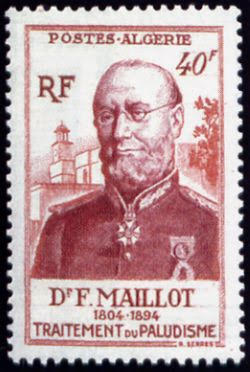
Effigy of Dr. F. Maillot
In honor of the Military Medical Corps
Dr. François-Clément Maillot (1804-1894)
It was the military doctor François-Clément Maillot (1804-1894) who generalized and codified the use of quinine. Considered at the beginning as a general febrifuge, it will have the merit of discerning its specific role and unlike the famous Broussais, we will recommend the use in high doses at the time of crises. From 1834 in Bône (Annaba), the mortality of fever patients in Maillot increased from 1 in 4 to 1 in 27. This does not mean the eradication of malaria which will have to wait for the vigorous measures of the Americans from 1942 to decrease in such a way that I have not observed a single serious case during all my Algerian studies; the D.D.T. freed us at that time from both malaria and typhus. Ecological restrictions hardly existed...
He was born in Briey, then belonging to the department of Moselle, on February 18, 1804. After completing his humanities at the Lycée de Metz, he entered the military training hospital of the same city as a student. Then, after passing through the Val-de-Grâce application hospital, he returned to Metz as a major doctor, before being assigned to Ajaccio. He then had the opportunity to observe the 'fevers', sometimes continuous, sometimes intermittent, which struck the soldiers garrisoned on the Isle of Beauty.
In 1832, Maillot was sent to Algeria. First in Algiers, where again, he had to treat feverish people, before being put in charge of the management of the military hospital in Bône where the health situation was catastrophic (1834). Of 5,500 men stationed in this city, 4,000 were hospitalized, a large number of them succumbing to pernicious attacks. In less than two months we recorded 300 deaths!
As soon as he took up his duties at the military hospital installed in precarious conditions, Maillot will institute the treatment of fever patients on completely new bases: abandonment of the diet to which the unfortunate people had been subjected until then, purgations and repeated bloodletting. He administers quinine sulfate in high doses proportionate to the severity of the cases, one and up to two grams per day. The results were not long in coming, mortality fell from 23% to less than 4% and convalescents left the hospital after a shortened stay.
But this treatment method raises strong criticism from Maillot's colleagues. It was not until the malaria congress, held in Algiers in 1881, that its merits were officially recognized and that Bugeaud's famous formula 'Ense et aratro' was transformed into 'Ense, aratro et quina'!
Maillot lived long enough to learn about the discovery of the malaria hematozoan by Alphonse Laveran and finally see his work rewarded. In 1888 a law proclaimed that 'the use of quinine sulfate in high doses and immediately in the treatment of fevers saved thousands of soldiers and was the salvation of colonization'; an annual pension of 6,000 F is granted to Maillot as a national reward.
Dr. François-Clément Maillot (1804-1894)
It was the military doctor François-Clément Maillot (1804-1894) who generalized and codified the use of quinine. Considered at the beginning as a general febrifuge, it will have the merit of discerning its specific role and unlike the famous Broussais, we will recommend the use in high doses at the time of crises. From 1834 in Bône (Annaba), the mortality of fever patients in Maillot increased from 1 in 4 to 1 in 27. This does not mean the eradication of malaria which will have to wait for the vigorous measures of the Americans from 1942 to decrease in such a way that I have not observed a single serious case during all my Algerian studies; the D.D.T. freed us at that time from both malaria and typhus. Ecological restrictions hardly existed...
He was born in Briey, then belonging to the department of Moselle, on February 18, 1804. After completing his humanities at the Lycée de Metz, he entered the military training hospital of the same city as a student. Then, after passing through the Val-de-Grâce application hospital, he returned to Metz as a major doctor, before being assigned to Ajaccio. He then had the opportunity to observe the 'fevers', sometimes continuous, sometimes intermittent, which struck the soldiers garrisoned on the Isle of Beauty.
In 1832, Maillot was sent to Algeria. First in Algiers, where again, he had to treat feverish people, before being put in charge of the management of the military hospital in Bône where the health situation was catastrophic (1834). Of 5,500 men stationed in this city, 4,000 were hospitalized, a large number of them succumbing to pernicious attacks. In less than two months we recorded 300 deaths!
As soon as he took up his duties at the military hospital installed in precarious conditions, Maillot will institute the treatment of fever patients on completely new bases: abandonment of the diet to which the unfortunate people had been subjected until then, purgations and repeated bloodletting. He administers quinine sulfate in high doses proportionate to the severity of the cases, one and up to two grams per day. The results were not long in coming, mortality fell from 23% to less than 4% and convalescents left the hospital after a shortened stay.
But this treatment method raises strong criticism from Maillot's colleagues. It was not until the malaria congress, held in Algiers in 1881, that its merits were officially recognized and that Bugeaud's famous formula 'Ense et aratro' was transformed into 'Ense, aratro et quina'!
Maillot lived long enough to learn about the discovery of the malaria hematozoan by Alphonse Laveran and finally see his work rewarded. In 1888 a law proclaimed that 'the use of quinine sulfate in high doses and immediately in the treatment of fevers saved thousands of soldiers and was the salvation of colonization'; an annual pension of 6,000 F is granted to Maillot as a national reward.