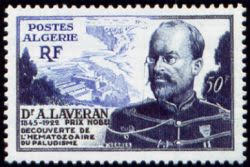
Effigy of Dr. A. Laveron
In honor of the Military Medical Corps
Dr. Alphonse Laveran (1845-1922)
Nobel PrizeDiscovery of the malaria hematozoa.
Alphonse Laveran (1845-1922), another military doctor, stayed in Constantine from 1878 to 1833; his discovery of the hematozoa earned him the Nobel Prize in 1907.
Laveran was born on June 18, 1845 in Paris, in the heart of the Latin Quarter, very close to Val-de-Grâce, where his father, a military doctor and professor, held the chair of 'diseases and epidemics in the armies'.
After completing his classical studies at the Sainte Barbe college, then at the Louis le Grand high school, the young Laveran joined the Strasbourg Military Health Service in 1863, of which our school in Lyon and then Lyon-Bron is the direct heir, as evidenced by the symbolism of your traditional badge. He then followed courses at the Faculty of Medicine in Strasbourg. Appointed hospital intern in 1866, he defended his doctoral thesis in 1868 and immediately joined the Val-de-Grâce School of Application. At the end in 1869, he was assigned to the Eastern Army and participated in the fighting at Gravelotte then in the siege and capitulation of Metz. Medically repatriated, he can nevertheless return to France and serve at the Lille Military Hospital until the end of hostilities. After the capitulation of Paris, in March 1871 he resumed his post at the Saint Martin hospital where he treated the wounded during the Commune insurrection.
Assigned in 1873 to the 10th Hussard in Pontivy, Laveran prepared for the Val-de-Grâce aggregation which he obtained the following year in the company of Lereboullet and Lacassagne (this is the famous 3 a promotion).
Laveran's classmate in Strasbourg, Alexandre Lacassagne was appointed professor of forensic medicine in Lyon in 1888 and the city, by giving his name to a large avenue, paid tribute to the man who is considered the creator of the forensic method. But Laveran's Lyon relations are not limited to his friendship for Lacassagne. A young associate of Val-de-Grâce in the chair inaugurated by his father, he not only wrote a treatise on military epidemiology, but also published in 1879, in collaboration with Professor J. Teissier of Lyon, a work on internal medicine very popular at the time.
In 1878, his time of aggregation finished, Laveran was assigned to the hospitals of the Constantine division, and successively to those of Bône, Biskra and Constantine, where he was promoted in 1879, medical major of the class. It was in Constantine, in 1880, that Laveran described, in the blood of a malarial soldier, pigmented spherical bodies identified with the malaria hematozoa, a fundamental discovery immediately reported to the Academy of Medicine and the Academy of Sciences. In 1882, in Italy he found the same parasitic elements among malaria sufferers in the Roman countryside.
In 1884 and for 10 years, Laveran became the fourth holder of the chair of 'military hygiene' in Val-de-Grâce, in which he succeeded Edmond Vallin, who in 1888 was the first director of the Avenue Berthelot Health School. During this period, Professor Laveran developed a vast program of practical teaching and wrote a remarkable treatise on hygiene. Elected to the National Academy of Medicine in 1893, then to the Academy of Sciences, he received the Jenner medal awarded by the Epidemiological Society of London.
After being promoted to Principal Physician, Laveran, having reached the end of his professorial term, requested an assignment near Paris, allowing him to continue his research without harming his medico-military functions. The hierarchical authorities of the time, taking umbrage at his scientific notoriety, instead of responding to this legitimate expectation, entrusted Laveran with the leadership of the Military Hospital of Lille and then with the direction of the Health Service of the 10th Army Corps in Nantes. Deprived of a hospital service capable of supporting his research and of a laboratory to carry it out, the illustrious scientist regretfully requested and obtained in 1886, at the age of 50, his retirement from the Army Health Service.
Ducloux and Roux then welcomed him to the Pasteur Institute and for this prestigious researcher, a second Pasteurian career began, entirely devoted to parasitic medicine. Malaria naturally occupies a privileged place. Ardent defender of Donald Ross, Laveran shows that in Camargue and Corsica, localities infested by malaria are areas favored by anopheles. The transmission of the hematozoa by the mosquito having finally been admitted, Laveran is heavily involved in the fight against mosquitoes but he also devotes essential work to trypanosomes and leishmanias.
In 1907, he founded the Society of Exotic Pathology which he chaired for 12 years and which would soon honor another prestigious alumnus of our school, Physician General Léon Lapeyssonie.
It was in 1907 that the Royal Carolin Institute in Stockholm awarded Alphonse Laveran the Nobel Prize in Physiology and Medicine for all of his work on the role of protozoa as infectious agents. The amount of the prize will be used to install a 'tropical diseases' laboratory at the Pasteur Institute where observations made in human parasitology will now converge from all over the world. The illustrious scholar is then very often in the spotlight. Member of many national and foreign learned societies, his merits are celebrated everywhere in Europe, America and Asia. Until his death in 1922, Laveran continued his research at the Pasteur Institute.
A world-renowned scientist, admirable worker of science, your godfather also left the memory of a Doctor and an Officer of high moral value. With a cold approach, not very talkative, measured, prudent, fair and good, he combined the combined reserve of the man from Flanders and Lorraine. Totally disinterested, with absolute moral independence, he went, foreign to the opinions of others, to the end of the path as a researcher that he had traced for himself.
Dr. Alphonse Laveran (1845-1922)
Nobel PrizeDiscovery of the malaria hematozoa.
Alphonse Laveran (1845-1922), another military doctor, stayed in Constantine from 1878 to 1833; his discovery of the hematozoa earned him the Nobel Prize in 1907.
Laveran was born on June 18, 1845 in Paris, in the heart of the Latin Quarter, very close to Val-de-Grâce, where his father, a military doctor and professor, held the chair of 'diseases and epidemics in the armies'.
After completing his classical studies at the Sainte Barbe college, then at the Louis le Grand high school, the young Laveran joined the Strasbourg Military Health Service in 1863, of which our school in Lyon and then Lyon-Bron is the direct heir, as evidenced by the symbolism of your traditional badge. He then followed courses at the Faculty of Medicine in Strasbourg. Appointed hospital intern in 1866, he defended his doctoral thesis in 1868 and immediately joined the Val-de-Grâce School of Application. At the end in 1869, he was assigned to the Eastern Army and participated in the fighting at Gravelotte then in the siege and capitulation of Metz. Medically repatriated, he can nevertheless return to France and serve at the Lille Military Hospital until the end of hostilities. After the capitulation of Paris, in March 1871 he resumed his post at the Saint Martin hospital where he treated the wounded during the Commune insurrection.
Assigned in 1873 to the 10th Hussard in Pontivy, Laveran prepared for the Val-de-Grâce aggregation which he obtained the following year in the company of Lereboullet and Lacassagne (this is the famous 3 a promotion).
Laveran's classmate in Strasbourg, Alexandre Lacassagne was appointed professor of forensic medicine in Lyon in 1888 and the city, by giving his name to a large avenue, paid tribute to the man who is considered the creator of the forensic method. But Laveran's Lyon relations are not limited to his friendship for Lacassagne. A young associate of Val-de-Grâce in the chair inaugurated by his father, he not only wrote a treatise on military epidemiology, but also published in 1879, in collaboration with Professor J. Teissier of Lyon, a work on internal medicine very popular at the time.
In 1878, his time of aggregation finished, Laveran was assigned to the hospitals of the Constantine division, and successively to those of Bône, Biskra and Constantine, where he was promoted in 1879, medical major of the class. It was in Constantine, in 1880, that Laveran described, in the blood of a malarial soldier, pigmented spherical bodies identified with the malaria hematozoa, a fundamental discovery immediately reported to the Academy of Medicine and the Academy of Sciences. In 1882, in Italy he found the same parasitic elements among malaria sufferers in the Roman countryside.
In 1884 and for 10 years, Laveran became the fourth holder of the chair of 'military hygiene' in Val-de-Grâce, in which he succeeded Edmond Vallin, who in 1888 was the first director of the Avenue Berthelot Health School. During this period, Professor Laveran developed a vast program of practical teaching and wrote a remarkable treatise on hygiene. Elected to the National Academy of Medicine in 1893, then to the Academy of Sciences, he received the Jenner medal awarded by the Epidemiological Society of London.
After being promoted to Principal Physician, Laveran, having reached the end of his professorial term, requested an assignment near Paris, allowing him to continue his research without harming his medico-military functions. The hierarchical authorities of the time, taking umbrage at his scientific notoriety, instead of responding to this legitimate expectation, entrusted Laveran with the leadership of the Military Hospital of Lille and then with the direction of the Health Service of the 10th Army Corps in Nantes. Deprived of a hospital service capable of supporting his research and of a laboratory to carry it out, the illustrious scientist regretfully requested and obtained in 1886, at the age of 50, his retirement from the Army Health Service.
Ducloux and Roux then welcomed him to the Pasteur Institute and for this prestigious researcher, a second Pasteurian career began, entirely devoted to parasitic medicine. Malaria naturally occupies a privileged place. Ardent defender of Donald Ross, Laveran shows that in Camargue and Corsica, localities infested by malaria are areas favored by anopheles. The transmission of the hematozoa by the mosquito having finally been admitted, Laveran is heavily involved in the fight against mosquitoes but he also devotes essential work to trypanosomes and leishmanias.
In 1907, he founded the Society of Exotic Pathology which he chaired for 12 years and which would soon honor another prestigious alumnus of our school, Physician General Léon Lapeyssonie.
It was in 1907 that the Royal Carolin Institute in Stockholm awarded Alphonse Laveran the Nobel Prize in Physiology and Medicine for all of his work on the role of protozoa as infectious agents. The amount of the prize will be used to install a 'tropical diseases' laboratory at the Pasteur Institute where observations made in human parasitology will now converge from all over the world. The illustrious scholar is then very often in the spotlight. Member of many national and foreign learned societies, his merits are celebrated everywhere in Europe, America and Asia. Until his death in 1922, Laveran continued his research at the Pasteur Institute.
A world-renowned scientist, admirable worker of science, your godfather also left the memory of a Doctor and an Officer of high moral value. With a cold approach, not very talkative, measured, prudent, fair and good, he combined the combined reserve of the man from Flanders and Lorraine. Totally disinterested, with absolute moral independence, he went, foreign to the opinions of others, to the end of the path as a researcher that he had traced for himself.