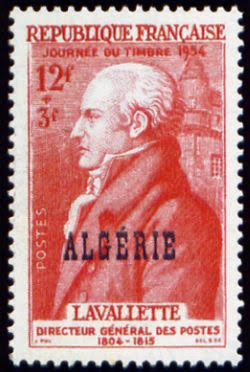
Effigy of Valletta
Stamp Day 1954
Antoine-Marie CHAMANS, Count of LAVALETTE (1769-1830)
Director of Posts of the 1st Empire from 1804 to 1814 and the Hundred Days
Best known for his incredible escape, Lavalette was born in Paris on October 14, 1769, a city in which his father was a lemonade maker. After good studies at the Collège d'Harcourt, young Antoine became secretary to the Librarian of Louis XVI, a certain Lefèvre d'Ormesson. Faced with the Revolution that broke out, Lavalette, initially favorable to new ideas, was frightened by the excesses it brought. He took refuge in the army and served three years in the Parisian national guards, then in the Legion of the Alps and in the Army of the Rhine where the famous Custine appointed him second lieutenant and aide-de-camp to Colonel Baraguey d'Hilliers.
The meeting with the future emperor took place in 1796. Indeed, Baraguey d'Hilliers, promoted to general in Italy, presented Lavalette to Bonaparte. Lavalette, who became one of General Bonaparte's main aides-de-camp, was responsible for several diplomatic missions in Tyrol and Léoben. Before his departure for Egypt, Bonaparte made him marry Emilie de Beauharnais (1781-1855), niece of Joséphine. The civil marriage was celebrated in Paris on April 22, 1798. Lavalette then participated in the capture of Malta, then was sent again on mission to Corfu, before joining the expeditionary force in Egypt.
He will be one of those who will return to France with Bonaparte. He participated in the coup d'état of 18 Brumaire. In January 1800, Talleyrand sent him on a diplomatic mission to Saxony to prepare a peace treaty with Austria. On his return, the First Consul appointed him administrator to the Sinking Fund, then to the Post Office Directorate, as central commissioner (1801) and Director General (March 19, 1804). The same year, Lavalette was appointed State Councilor, Interior section. As a man of confidence, he gains control of the famous Black Cabinet. This 'unofficial' institution was responsible for intercepting certain mail. He spent eleven years at the Post Office and in the Black Cabinet.
During the First Restoration, Lavalette did not join the Bourbon camp. In 1815, hearing of the landing of the Emperor, he went to the Ministry of Posts (then rue du Coq-Héron, current 1st arrondissement of Paris) to resume his duties. After Waterloo, Napoleon received him at Malmaison and offered to accompany him in exile. 'I refused to accompany him', writes Lavalette in his 'Mémoires'. Before continuing: 'I have a thirteen-year-old daughter, my wife is four months pregnant, I cannot decide to separate from her; give me some time, and I will join you wherever you are' Lavalette will not have this possibility: arrested at his home on July 18, 1815, he is taken to the Police Prefecture then incarcerated at the Conciergerie. There he will meet Marshal Ney who is also a prisoner.
Brought before the Court of Assizes for conspiracy and usurpation of functions, he was sentenced to death on November 21, 1815. His appeal was rejected and he did not obtain a pardon from the impotent Louis XVIII, who was only too happy to respond to the demands of the 'Ultras'.
The day before the execution, Madame de Lavalette and her daughter visited their husband and father. Lavalette exchanges his clothes with those of his wife and goes out on his daughter's arm, incognito, a handkerchief hiding his face.
The escapee found refuge in the attic of the Ministry of Foreign Affairs, then left Paris on January 8, 1816 with the complicity of three English officers: Bruce, Hutchinson and General Wilson. He puts on the British uniform and reaches Belgium. Then Antoine de Lavalette heads alone towards Bavaria, a country where he will reside for several years, with the kindness of Eugène de Beauharnais, Hortense and King Maximilien.
Subsequently pardoned, he was finally able to return to Paris. Madame de Lavalette, already shaken by the loss of her second child (October 13, 1815), remained imprisoned in the Conciergerie and was not released until January 23, 1816. Psychologically weakened by so many ordeals, Emilie de Lavalette disappeared on June 18, 1855.
A few years earlier, on February 15, 1830, Count Antoine de Lavalette had died, probably of lung cancer. At the end of a ceremony which brought together the great names of the Empire, he was buried at the Père Lachaise Cemetery. His wife will come to join him.
Antoine-Marie CHAMANS, Count of LAVALETTE (1769-1830)
Director of Posts of the 1st Empire from 1804 to 1814 and the Hundred Days
Best known for his incredible escape, Lavalette was born in Paris on October 14, 1769, a city in which his father was a lemonade maker. After good studies at the Collège d'Harcourt, young Antoine became secretary to the Librarian of Louis XVI, a certain Lefèvre d'Ormesson. Faced with the Revolution that broke out, Lavalette, initially favorable to new ideas, was frightened by the excesses it brought. He took refuge in the army and served three years in the Parisian national guards, then in the Legion of the Alps and in the Army of the Rhine where the famous Custine appointed him second lieutenant and aide-de-camp to Colonel Baraguey d'Hilliers.
The meeting with the future emperor took place in 1796. Indeed, Baraguey d'Hilliers, promoted to general in Italy, presented Lavalette to Bonaparte. Lavalette, who became one of General Bonaparte's main aides-de-camp, was responsible for several diplomatic missions in Tyrol and Léoben. Before his departure for Egypt, Bonaparte made him marry Emilie de Beauharnais (1781-1855), niece of Joséphine. The civil marriage was celebrated in Paris on April 22, 1798. Lavalette then participated in the capture of Malta, then was sent again on mission to Corfu, before joining the expeditionary force in Egypt.
He will be one of those who will return to France with Bonaparte. He participated in the coup d'état of 18 Brumaire. In January 1800, Talleyrand sent him on a diplomatic mission to Saxony to prepare a peace treaty with Austria. On his return, the First Consul appointed him administrator to the Sinking Fund, then to the Post Office Directorate, as central commissioner (1801) and Director General (March 19, 1804). The same year, Lavalette was appointed State Councilor, Interior section. As a man of confidence, he gains control of the famous Black Cabinet. This 'unofficial' institution was responsible for intercepting certain mail. He spent eleven years at the Post Office and in the Black Cabinet.
During the First Restoration, Lavalette did not join the Bourbon camp. In 1815, hearing of the landing of the Emperor, he went to the Ministry of Posts (then rue du Coq-Héron, current 1st arrondissement of Paris) to resume his duties. After Waterloo, Napoleon received him at Malmaison and offered to accompany him in exile. 'I refused to accompany him', writes Lavalette in his 'Mémoires'. Before continuing: 'I have a thirteen-year-old daughter, my wife is four months pregnant, I cannot decide to separate from her; give me some time, and I will join you wherever you are' Lavalette will not have this possibility: arrested at his home on July 18, 1815, he is taken to the Police Prefecture then incarcerated at the Conciergerie. There he will meet Marshal Ney who is also a prisoner.
Brought before the Court of Assizes for conspiracy and usurpation of functions, he was sentenced to death on November 21, 1815. His appeal was rejected and he did not obtain a pardon from the impotent Louis XVIII, who was only too happy to respond to the demands of the 'Ultras'.
The day before the execution, Madame de Lavalette and her daughter visited their husband and father. Lavalette exchanges his clothes with those of his wife and goes out on his daughter's arm, incognito, a handkerchief hiding his face.
The escapee found refuge in the attic of the Ministry of Foreign Affairs, then left Paris on January 8, 1816 with the complicity of three English officers: Bruce, Hutchinson and General Wilson. He puts on the British uniform and reaches Belgium. Then Antoine de Lavalette heads alone towards Bavaria, a country where he will reside for several years, with the kindness of Eugène de Beauharnais, Hortense and King Maximilien.
Subsequently pardoned, he was finally able to return to Paris. Madame de Lavalette, already shaken by the loss of her second child (October 13, 1815), remained imprisoned in the Conciergerie and was not released until January 23, 1816. Psychologically weakened by so many ordeals, Emilie de Lavalette disappeared on June 18, 1855.
A few years earlier, on February 15, 1830, Count Antoine de Lavalette had died, probably of lung cancer. At the end of a ceremony which brought together the great names of the Empire, he was buried at the Père Lachaise Cemetery. His wife will come to join him.