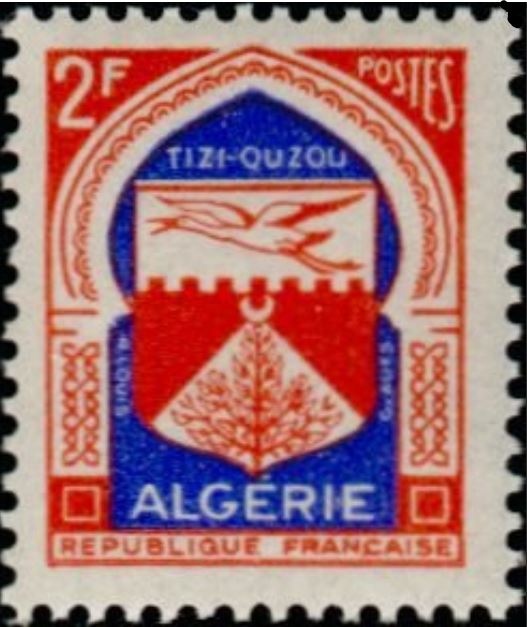
Coat of arms of Tizi Ouzou
Kabylia is a very beautiful mountainous region. The villages hang proudly on its mountains.
Tizi-Ouzou in Kabyle means 'broom pass'; but it is to these mountain flowers which cover these slopes that the city owes its name.
Tizi-Ouzou is located halfway between the Mediterranean and the high peaks of Djurdjura.
The tourist sites are as numerous as they are varied, depending on the seasons:
- For sports enthusiasts (skiing, mountaineering, hunting, caving, hiking, etc.),
- For restful stays in their hotels, Tala Guilef and Tikjda are the best corners of the country. Tala Guilef is a ski, mountaineering and rest resort at an altitude of 1,500 m, on the edge of a cedar and oak forest with 700 hectares of slopes.
On the Col de Tirourda (limit of the Soummam Valley), guides will lead good walkers to two famous places in the region:
- The Macchabee Cave, at the bottom of which lies a mysterious mummy;
- and the Monkey Cemetery cavity where there are many skeletons of these animals.
The craftsmanship is very developed:
- Thus utility pottery is the main artisanal production of Arbaâ Nath Irathen.
- Icheridene are known for the abundance and quality of their cherries, hence La Fête des Cerises.
- Ath Hichem, the neighboring village of Ain El Hammam (1089 m) specializes in weaving short rugs, table mats, etc. decorated with brightly colored patterns.
- At Ath Yenni (800 to 900 m), tablecloths and napkins are cut from fabric with red, black and yellow stripes, used to make foutas (women's skirts).
- Traditionally, the Ath Yenni are goldsmiths whose silver jewelry inlaid with coral and enamel is appreciated well beyond Kabylia. Today's artisans train cabinetmakers and sculptors who must not deny traditional patterns and shapes.
- While Meklaâ and Djemâ N'Saridj devote themselves entirely to crafts: foutas, red earthenware pottery, basketry in raffia or reed, sculpture on wooden panels, ceramics and wrought iron...
Tizi-Ouzou in Kabyle means 'broom pass'; but it is to these mountain flowers which cover these slopes that the city owes its name.
Tizi-Ouzou is located halfway between the Mediterranean and the high peaks of Djurdjura.
The tourist sites are as numerous as they are varied, depending on the seasons:
- For sports enthusiasts (skiing, mountaineering, hunting, caving, hiking, etc.),
- For restful stays in their hotels, Tala Guilef and Tikjda are the best corners of the country. Tala Guilef is a ski, mountaineering and rest resort at an altitude of 1,500 m, on the edge of a cedar and oak forest with 700 hectares of slopes.
On the Col de Tirourda (limit of the Soummam Valley), guides will lead good walkers to two famous places in the region:
- The Macchabee Cave, at the bottom of which lies a mysterious mummy;
- and the Monkey Cemetery cavity where there are many skeletons of these animals.
The craftsmanship is very developed:
- Thus utility pottery is the main artisanal production of Arbaâ Nath Irathen.
- Icheridene are known for the abundance and quality of their cherries, hence La Fête des Cerises.
- Ath Hichem, the neighboring village of Ain El Hammam (1089 m) specializes in weaving short rugs, table mats, etc. decorated with brightly colored patterns.
- At Ath Yenni (800 to 900 m), tablecloths and napkins are cut from fabric with red, black and yellow stripes, used to make foutas (women's skirts).
- Traditionally, the Ath Yenni are goldsmiths whose silver jewelry inlaid with coral and enamel is appreciated well beyond Kabylia. Today's artisans train cabinetmakers and sculptors who must not deny traditional patterns and shapes.
- While Meklaâ and Djemâ N'Saridj devote themselves entirely to crafts: foutas, red earthenware pottery, basketry in raffia or reed, sculpture on wooden panels, ceramics and wrought iron...