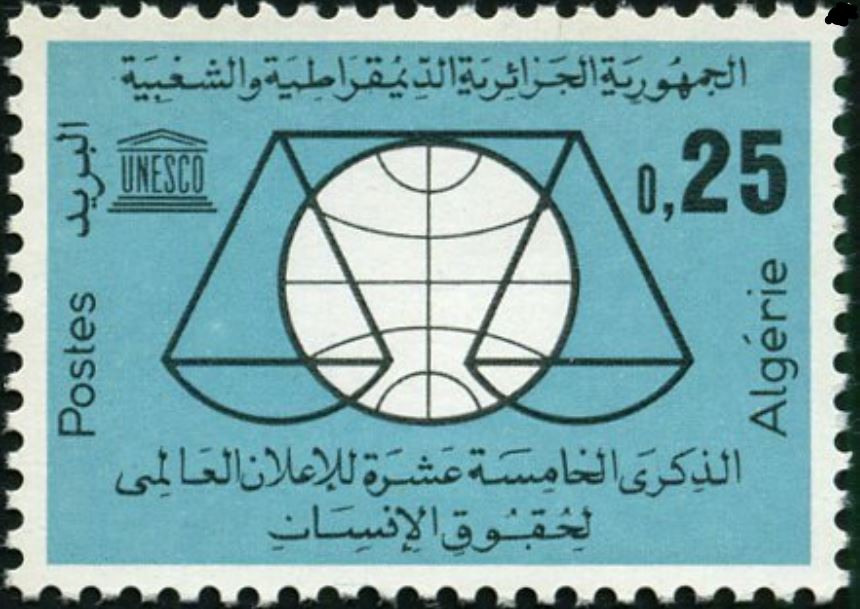
Universal Declaration of Human Rights
December 10, 1963 marks the 15th anniversary of the Universal Declaration of Human Rights. Adopted in 1948 in Paris by the United Nations General Assembly in its resolution 217 A (III) and ratified by the 58 member states, it constitutes protection against the atrocities committed during the Second World War.
This declaration establishes, at the international level, human rights and fundamental freedoms, making them inalienable. Without distorting already existing texts, in particular the Declaration of the Rights of Man and of the Citizen (France, 1789), the 30 articles of the document proclaimed in 1948 prescribe for the entire international community the guarantee of fundamental civil and political rights, supplemented by the protection of economic and social rights.
After 132 years of French colonization, Algeria, which regained its independence in 1962, marked its entry into the concert of nations by fully adhering to the principle of consecrating individual freedoms, an internationally recognized value. Although having no legal significance, this declaration remains an affirmation of the existence and preservation of rights relating to the person and human dignity.
This declaration establishes, at the international level, human rights and fundamental freedoms, making them inalienable. Without distorting already existing texts, in particular the Declaration of the Rights of Man and of the Citizen (France, 1789), the 30 articles of the document proclaimed in 1948 prescribe for the entire international community the guarantee of fundamental civil and political rights, supplemented by the protection of economic and social rights.
After 132 years of French colonization, Algeria, which regained its independence in 1962, marked its entry into the concert of nations by fully adhering to the principle of consecrating individual freedoms, an internationally recognized value. Although having no legal significance, this declaration remains an affirmation of the existence and preservation of rights relating to the person and human dignity.