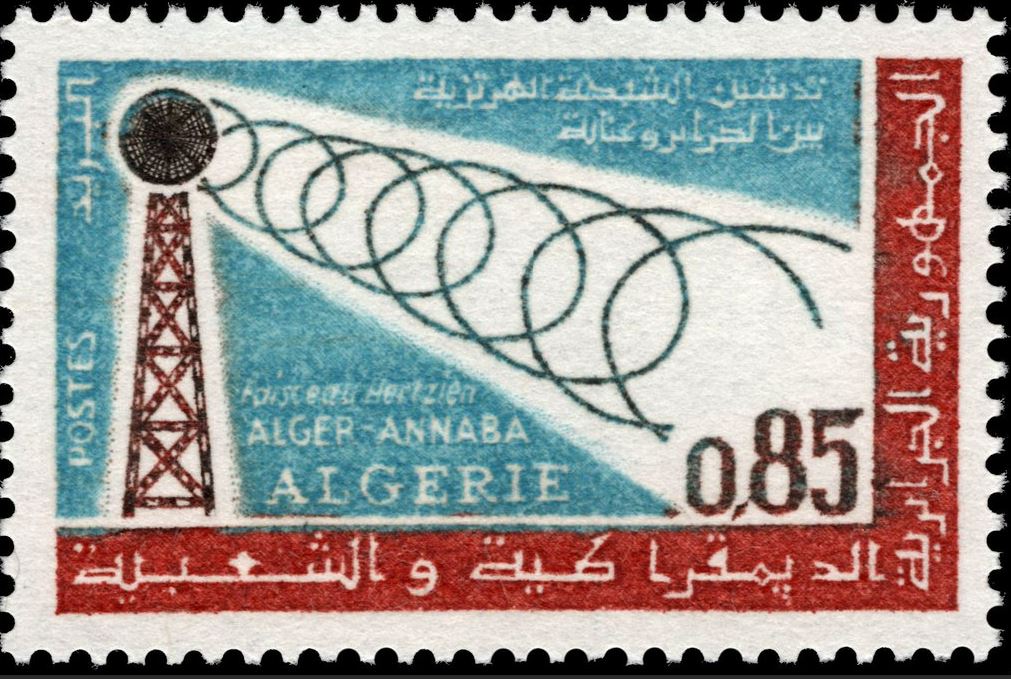
Algiers-Bône Hertzian Link (Annaba)
The inauguration of the radio link between Algiers and Annaba marks Algeria's desire to follow the path of technological evolution in which telecommunications play an essential role.
The Algiers-Annaba link and its extension to foreign radio stations strengthen the infrastructure of the telecommunications network. This new connection also ensures the qualitative improvement of communication relations between major Algerian cities and complements the possibilities already offered by underground coaxial cables.
Radio wave connections, which make it possible to overcome the constraints of cables, are carried out by short waves (radiotelephony) or by ultra-short waves (radio beams). The telephone connection by radio relay is an international invention that dates back to the 19th century.
In 1887, the German Heinrich Hertz demonstrated, by producing electric sparks in a spark gap, the existence of electromagnetic waves emitted by an electric discharge, a process designed at the same time by the Englishman James Clerck Maxwell. In 1927 the first radio telephone circuit was put into service between London and New York.
In 1935, only four intercontinental telephone connections were open to the public from Paris, via transmitters located in Pontoise (France) and receivers located in Noiseau (France). Meanwhile, twenty transatlantic telegraph cables are still in service.
The development of telephone links by radio relay only took place in Europe after the Second World War, in the 1950s precisely. Since regaining independence, the Algerian State has integrated into its development strategy the need to be in line with current technological advances.
In 1964, Algeria had numerous telephone links by radio linking cities separated by very large distances.
The Algiers-Annaba link and its extension to foreign radio stations strengthen the infrastructure of the telecommunications network. This new connection also ensures the qualitative improvement of communication relations between major Algerian cities and complements the possibilities already offered by underground coaxial cables.
Radio wave connections, which make it possible to overcome the constraints of cables, are carried out by short waves (radiotelephony) or by ultra-short waves (radio beams). The telephone connection by radio relay is an international invention that dates back to the 19th century.
In 1887, the German Heinrich Hertz demonstrated, by producing electric sparks in a spark gap, the existence of electromagnetic waves emitted by an electric discharge, a process designed at the same time by the Englishman James Clerck Maxwell. In 1927 the first radio telephone circuit was put into service between London and New York.
In 1935, only four intercontinental telephone connections were open to the public from Paris, via transmitters located in Pontoise (France) and receivers located in Noiseau (France). Meanwhile, twenty transatlantic telegraph cables are still in service.
The development of telephone links by radio relay only took place in Europe after the Second World War, in the 1950s precisely. Since regaining independence, the Algerian State has integrated into its development strategy the need to be in line with current technological advances.
In 1964, Algeria had numerous telephone links by radio linking cities separated by very large distances.