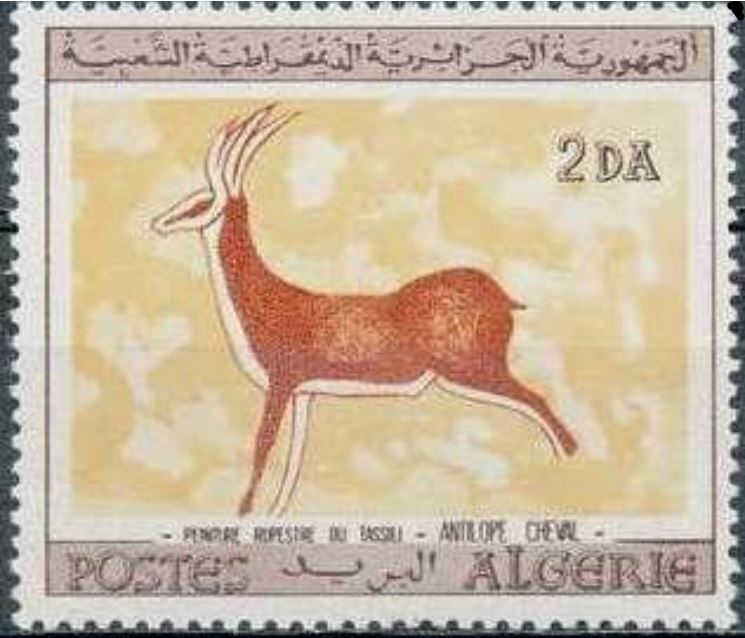
Rock Drawings of Tassili N'ajjer Antelope Horse
The vast sandstone plateau of Tassili N'Ajjer conceals picturesque sites where there are abundant rock engravings and magnificent paintings of certain archaeological value and which are the admiration of many tourists.
It constitutes a veritable “stone library”. The revelation of these artistic and historical riches has aroused considerable interest in global scientific circles. Tassili has also become the center of prehistoric rock art, undoubtedly the richest in the world.
The discoveries trace the past of the Sahara and also tell us about the social, economic and political organization of these populations. Indeed, if until then, one could think that they constituted more or less anarchic groups, a high quality panel, noted at In Itimien, attests to the existence of a hierarchy and organized troops with uniforms and supervision.
Likewise, a judgment scene shows high dignitaries in ceremonial attire. Another group of paintings is represented by numerous frescoes depicting herders of oxen or cattle, as well as chariots and horses.
The representation, arrangement and distribution of these frescoes admirably retrace the migrations of equestrian populations and the routes they took to cross the desert. In Jabbaren, Tissoukal, In Itimien or Mertoutek, frescoes, with characters and large animals of a very characteristic type, evoke the cults practiced in the distant era of the emerging Neolithic, around 6000 BC.
Animals, such as the elephant, the ancient buffalo and the wild ox, played a religious role, as several of them can be seen worshiped by women in prayer. Thanks to all these remarkable works of art, the Sahara, particularly Tassili, can be considered the most important natural museum in the world.
It is therefore essential that measures be taken by public authorities to protect these unique riches in the world.
It constitutes a veritable “stone library”. The revelation of these artistic and historical riches has aroused considerable interest in global scientific circles. Tassili has also become the center of prehistoric rock art, undoubtedly the richest in the world.
The discoveries trace the past of the Sahara and also tell us about the social, economic and political organization of these populations. Indeed, if until then, one could think that they constituted more or less anarchic groups, a high quality panel, noted at In Itimien, attests to the existence of a hierarchy and organized troops with uniforms and supervision.
Likewise, a judgment scene shows high dignitaries in ceremonial attire. Another group of paintings is represented by numerous frescoes depicting herders of oxen or cattle, as well as chariots and horses.
The representation, arrangement and distribution of these frescoes admirably retrace the migrations of equestrian populations and the routes they took to cross the desert. In Jabbaren, Tissoukal, In Itimien or Mertoutek, frescoes, with characters and large animals of a very characteristic type, evoke the cults practiced in the distant era of the emerging Neolithic, around 6000 BC.
Animals, such as the elephant, the ancient buffalo and the wild ox, played a religious role, as several of them can be seen worshiped by women in prayer. Thanks to all these remarkable works of art, the Sahara, particularly Tassili, can be considered the most important natural museum in the world.
It is therefore essential that measures be taken by public authorities to protect these unique riches in the world.