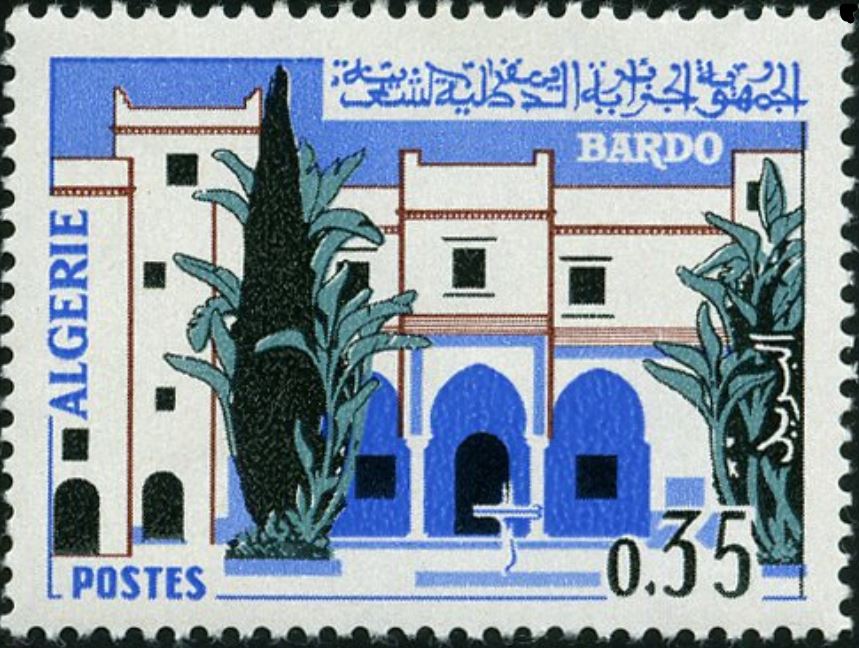
Bardo Museum Algiers
The Bardo National Museum is an Algerian archaeological and ethnographic museum located in the commune of Sidi M'Hamed, in the wilaya of Algiers, at the top of Boulevard Didouche-Mourad, ex-rue Michelet. It thus dominates Avenue Ahmed Ghermoul and the Mustapha Pacha hospital. It was called the Bardo Museum before taking its current name in 1985. The Bardo villa was built at the end of the 18th century by a rich exiled Tunisian, Hadj "Omar" or "Mustafa" Ben Omar. In 1830, the villa was assigned to General Maurice Exelmans. In 1879, an extension in the lower part was built by its last owner, the Frenchman Pierre Joret, son of the builder of the railway from Algiers to Constantine Henri Joret. Pierre Joret's sister, Mme Frémont, agreed in 1926 to cede the villa to the French State. Intended to be closer to the Musée de l'Homme (Paris), the building was inaugurated in 1930 as a museum of ethnography and indigenous art2, on the occasion of the centenary of French Algeria, under the notable leadership of Maurice Reygasse3. Classified by decree as a "historical monument" on September 1, 19854, the museum was classified as a "national museum" on November 12, 1985. The villa also houses the headquarters of the National Center for Prehistoric, Anthropological and Historical Research (CNRPAH)5, a public establishment of a scientific and technological nature, whose areas of research overlap prehistory, anthropology and history.