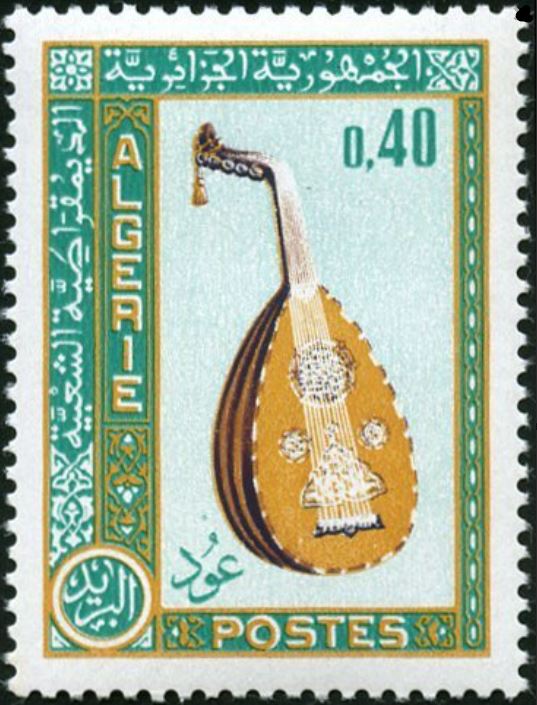
Lute
In Algeria, as throughout the Maghreb, we continue to call Arab musical art Andalusian music, in preference to a decisive stage of its evolution.
It is the heritage of a long tradition which, from Baghdad to Cordoba, from Cordoba to Granada, then from Granada to Tlemcen, Algiers, Bougie, Constantine, has found itself so perfectly assimilated, individualized, personalized since the tragic ebb of the Muslims of Spain.
This music appears, without doubt, as the national music, the classical music of Algeria.
The most glorious of his instruments is the lute. We can also cite the rebab and the kuitra.
The lute (‘oud), whose origins date back to ancient times, occupies a large place in the history of Arab music.
It is made up of a pear-shaped resonance box. The soundboard is decorated in the center by one or three rosettes, finely openworked and decorated with ivory or mother-of-pearl inlays.
The strings, five in number in the classical type, are plucked using an eagle feather.
The lute is currently the most popular musical instrument in the Arab world.
It is the heritage of a long tradition which, from Baghdad to Cordoba, from Cordoba to Granada, then from Granada to Tlemcen, Algiers, Bougie, Constantine, has found itself so perfectly assimilated, individualized, personalized since the tragic ebb of the Muslims of Spain.
This music appears, without doubt, as the national music, the classical music of Algeria.
The most glorious of his instruments is the lute. We can also cite the rebab and the kuitra.
The lute (‘oud), whose origins date back to ancient times, occupies a large place in the history of Arab music.
It is made up of a pear-shaped resonance box. The soundboard is decorated in the center by one or three rosettes, finely openworked and decorated with ivory or mother-of-pearl inlays.
The strings, five in number in the classical type, are plucked using an eagle feather.
The lute is currently the most popular musical instrument in the Arab world.