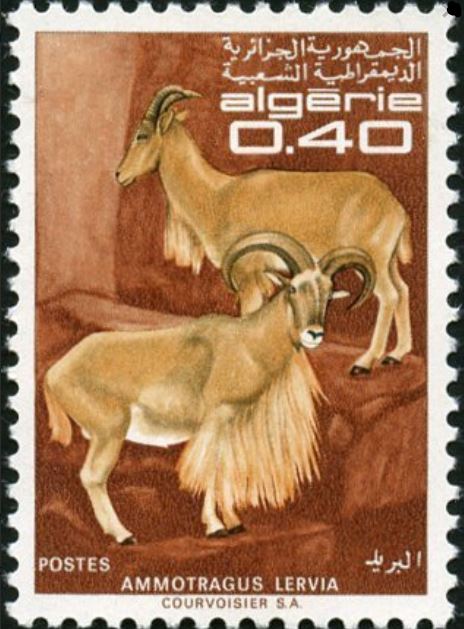
Mouflon (Ammotragus Lervia)
Barbary sheep Ammotragus lervia
The mouflon is, in the Maghreb, the only true representative, among large wild mammals, of the specifically African fauna.
It belongs to the Ovid family. Formerly very abundant in Berberia, it frequented all the mountains of the Algerian Tell as evidenced by the bones found in the caves of Djurdjura.
Currently, it is relegated to the central and northern Sahara. The mouflon is a powerful animal whose heavy form hides exceptional flexibility.
Its massive head bears, in both males and females, voluminous brown horns, planted almost side by side at the top of the forehead and forming a sort of right angle between them.
They then spread towards the back of the neck, describing a quarter turn. They can reach 0.84 m.
The mouflon has keen eyesight and a particularly subtle sense of smell. The coat is uniformly brownish fawn in both sexes, but the color may vary slightly depending on the region.
Under his neck he has a fringe of long, lighter hair which hangs like a mane and also long tufts reaching down to his knees, resembling cuffs.
It is a rock animal. It lives most often isolated, sometimes in small hordes of 5 or 6 under the authority of an old male who is always alert. In general, the mouflon stays on a ridge or in a pass.
Extremely suspicious by nature, as soon as he senses danger or simply feels disturbed, he runs off without noise, without precise direction and without turning around. At dusk, it normally leaves its lair to reach the shallows where it finds its food.
The mouflon is, in the Maghreb, the only true representative, among large wild mammals, of the specifically African fauna.
It belongs to the Ovid family. Formerly very abundant in Berberia, it frequented all the mountains of the Algerian Tell as evidenced by the bones found in the caves of Djurdjura.
Currently, it is relegated to the central and northern Sahara. The mouflon is a powerful animal whose heavy form hides exceptional flexibility.
Its massive head bears, in both males and females, voluminous brown horns, planted almost side by side at the top of the forehead and forming a sort of right angle between them.
They then spread towards the back of the neck, describing a quarter turn. They can reach 0.84 m.
The mouflon has keen eyesight and a particularly subtle sense of smell. The coat is uniformly brownish fawn in both sexes, but the color may vary slightly depending on the region.
Under his neck he has a fringe of long, lighter hair which hangs like a mane and also long tufts reaching down to his knees, resembling cuffs.
It is a rock animal. It lives most often isolated, sometimes in small hordes of 5 or 6 under the authority of an old male who is always alert. In general, the mouflon stays on a ridge or in a pass.
Extremely suspicious by nature, as soon as he senses danger or simply feels disturbed, he runs off without noise, without precise direction and without turning around. At dusk, it normally leaves its lair to reach the shallows where it finds its food.