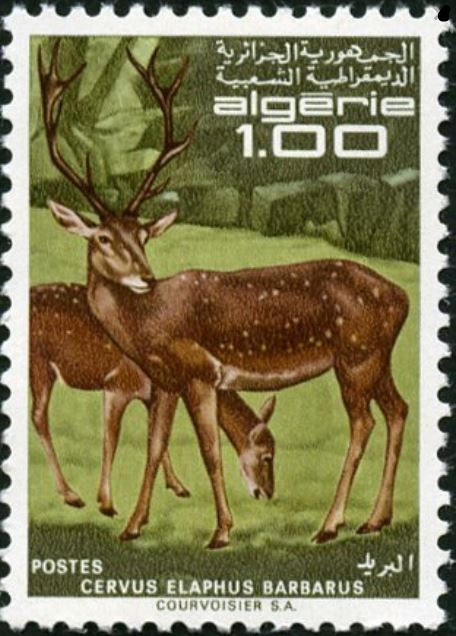
Barbary deer (Cervus Elaphus Barbarus)
Barbary deer Cervus elaphus barbarus
After having, over geological time, occupied a preponderant place among the fauna of the northern part of the African continent, the genus Cervus is currently only represented by a single species, the Barbary deer, located in a narrow coastal strip of eastern Algeria.
Among the various deer that lived in Africa, it is the only one whose survival can be confirmed to this day.
But the species is endangered. Because deer have always been widely hunted, especially in Roman times, as evidenced by the numerous mosaics found near Constantine and Algiers, depicting hunting scenes.
Around 1740, he still lived around Skikda and in the Edough forest, above Annaba, where for a long time his antlers were still discovered buried in the humus.
Currently, there remain some 300 to 400 deer, variously distributed in the forest regions of Annaba, Bouchegouf and especially El Kalaâ.
It is a large animal, with a height of 1.30 m to 1.40 m at the shoulder and a live weight of 150 to 225 kg; the female, smaller, barely reaches 0.90 m to 1 m and weighs 100 to 150 kg.
The body is entirely covered in hair, the color of which varies depending on the season. In summer, the coat is light brown, dotted with white spots arranged in longitudinal lines. In winter, the hair lengthens and takes on a dark brown color.
The antlers reach a development of 80 cm with a spacing of 65 cm between the points and a base circumference of 15 cm. Their coloring is generally brown with lighter ends.
The Barbary deer feeds on brush, grasses, young shoots, scrub and cork oak leaves. In spring and summer, it does not hesitate to leave the forests, especially at night.
After having, over geological time, occupied a preponderant place among the fauna of the northern part of the African continent, the genus Cervus is currently only represented by a single species, the Barbary deer, located in a narrow coastal strip of eastern Algeria.
Among the various deer that lived in Africa, it is the only one whose survival can be confirmed to this day.
But the species is endangered. Because deer have always been widely hunted, especially in Roman times, as evidenced by the numerous mosaics found near Constantine and Algiers, depicting hunting scenes.
Around 1740, he still lived around Skikda and in the Edough forest, above Annaba, where for a long time his antlers were still discovered buried in the humus.
Currently, there remain some 300 to 400 deer, variously distributed in the forest regions of Annaba, Bouchegouf and especially El Kalaâ.
It is a large animal, with a height of 1.30 m to 1.40 m at the shoulder and a live weight of 150 to 225 kg; the female, smaller, barely reaches 0.90 m to 1 m and weighs 100 to 150 kg.
The body is entirely covered in hair, the color of which varies depending on the season. In summer, the coat is light brown, dotted with white spots arranged in longitudinal lines. In winter, the hair lengthens and takes on a dark brown color.
The antlers reach a development of 80 cm with a spacing of 65 cm between the points and a base circumference of 15 cm. Their coloring is generally brown with lighter ends.
The Barbary deer feeds on brush, grasses, young shoots, scrub and cork oak leaves. In spring and summer, it does not hesitate to leave the forests, especially at night.