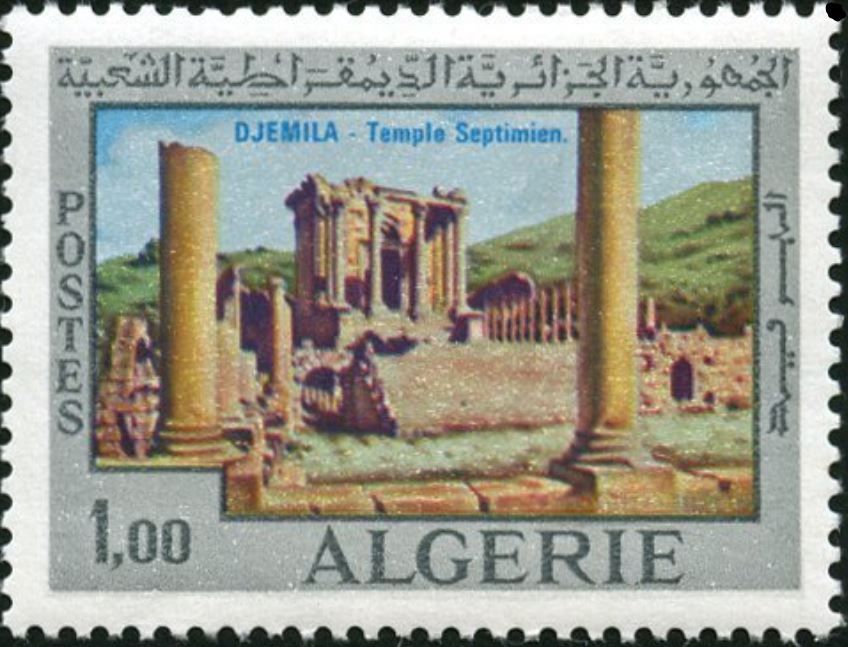
Septimius Temple of Djemila
The colony of Cuicul, today's Djemila, a Roman sentinel in the heart of a mountain range, was built between Sétif and Constantine under the reign of Emperor Nerva, in the last years of the first century of the Christian era.
The first inhabitants chose a rocky spur between Wadi Guergour and Wadi Betame. The layout of the land did not allow the theoretical plan of the Roman colonies to be realized in Djemila, the square enclosure itself divided into squares by north-south or cardine streets and east-west or decumani streets.
The city stretched from north to south, along a main cardo. Cuicul first had a forum as its center; on the paving of the square stood numerous statues. The forum was surrounded by public buildings such as the curia, the capitol, a basilica and a market.
Little by little, during the 2nd century, Cuicul became richer and developed. The enclosure was soon overwhelmed, an entire southern suburb was built and the center of urban activity moved south. This movement resulted, in the first third of the 3rd century, in the creation of a second forum.
Paved like the old forum, but larger and less crowded, the new forum extends on either side of the extended cardo. Two monuments stand out and date the entire square: one is the triumphal arch built by the colony of Cuicul, in 216, in honor of the emperor Caracalla and his parents; the other is a large temple preceded by a high staircase and which the colony dedicated in 229 to the worship of the imperial family of the Severus dynasty.
The first inhabitants chose a rocky spur between Wadi Guergour and Wadi Betame. The layout of the land did not allow the theoretical plan of the Roman colonies to be realized in Djemila, the square enclosure itself divided into squares by north-south or cardine streets and east-west or decumani streets.
The city stretched from north to south, along a main cardo. Cuicul first had a forum as its center; on the paving of the square stood numerous statues. The forum was surrounded by public buildings such as the curia, the capitol, a basilica and a market.
Little by little, during the 2nd century, Cuicul became richer and developed. The enclosure was soon overwhelmed, an entire southern suburb was built and the center of urban activity moved south. This movement resulted, in the first third of the 3rd century, in the creation of a second forum.
Paved like the old forum, but larger and less crowded, the new forum extends on either side of the extended cardo. Two monuments stand out and date the entire square: one is the triumphal arch built by the colony of Cuicul, in 216, in honor of the emperor Caracalla and his parents; the other is a large temple preceded by a high staircase and which the colony dedicated in 229 to the worship of the imperial family of the Severus dynasty.