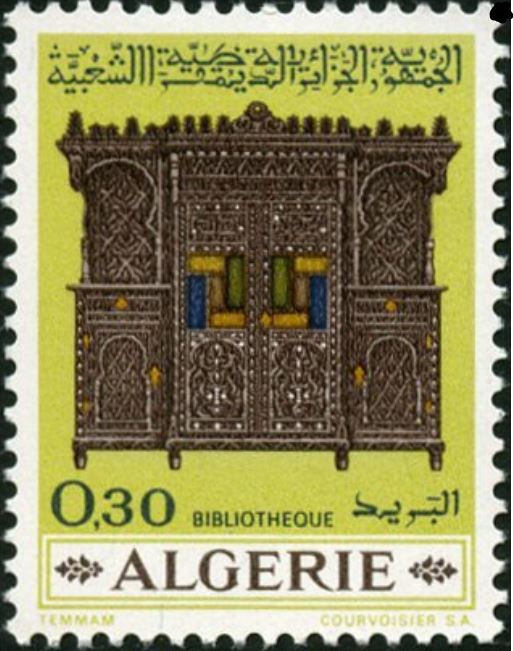
Library
Despite the vicissitudes of time, craftsmanship in Algeria, stemming from centuries-old traditions, has preserved the tradition of beautiful pieces of art. Since independence, it has experienced real growth with the creation of numerous workshops and manufacturing centers in all regions of the country.
Exhibitions of works by Algerian artisans are very successful with the national and international public. We admire the quality, the beautiful material, the elegance of the shapes, the richness of the colors, the decor; we appreciate the various techniques of these ancient industries still practiced in Algeria and among which we can cite brassware, artistic carpentry and embroidered leather.
The ornate coppers, trays, couscous dishes, sugar bowls and other domestic objects are the works of the coppersmith who, seated in front of his easel, models the object by rhythmic hammer blows.
The floral or geometric decoration is either traced with a chisel and hatched with parallel lines, or chiseled and inlaid with silver or pewter. Sandblasting is also practiced. Artistic woodworking provides, among other works, magnificent bookcases, sideboards and very beautiful sets decorated with rich Hispano-Moorish ornamentation with well-distributed relief.
Moldings, assemblies, turning and cutting are ways that give this joinery a pleasing appearance to the eye. The wood species used are those of the country: cedar, walnut, larch, thuja, etc. and some imported wood for decoration. Embroidery on leather consists of covering with metal threads, gold or silver, a pattern cut out of the leather or cardboard which forms the filling and gives the embroidery a relief; often the reliefs have glitter.
The design is extremely elegant and the execution requires great manual skill. Making harnesses, often very rich, is the essential work of embroiderers. The saddle covers have the sides, pommel and tree entirely covered with embroidery as well as the headpiece, blinders and chest.
Exhibitions of works by Algerian artisans are very successful with the national and international public. We admire the quality, the beautiful material, the elegance of the shapes, the richness of the colors, the decor; we appreciate the various techniques of these ancient industries still practiced in Algeria and among which we can cite brassware, artistic carpentry and embroidered leather.
The ornate coppers, trays, couscous dishes, sugar bowls and other domestic objects are the works of the coppersmith who, seated in front of his easel, models the object by rhythmic hammer blows.
The floral or geometric decoration is either traced with a chisel and hatched with parallel lines, or chiseled and inlaid with silver or pewter. Sandblasting is also practiced. Artistic woodworking provides, among other works, magnificent bookcases, sideboards and very beautiful sets decorated with rich Hispano-Moorish ornamentation with well-distributed relief.
Moldings, assemblies, turning and cutting are ways that give this joinery a pleasing appearance to the eye. The wood species used are those of the country: cedar, walnut, larch, thuja, etc. and some imported wood for decoration. Embroidery on leather consists of covering with metal threads, gold or silver, a pattern cut out of the leather or cardboard which forms the filling and gives the embroidery a relief; often the reliefs have glitter.
The design is extremely elegant and the execution requires great manual skill. Making harnesses, often very rich, is the essential work of embroiderers. The saddle covers have the sides, pommel and tree entirely covered with embroidery as well as the headpiece, blinders and chest.