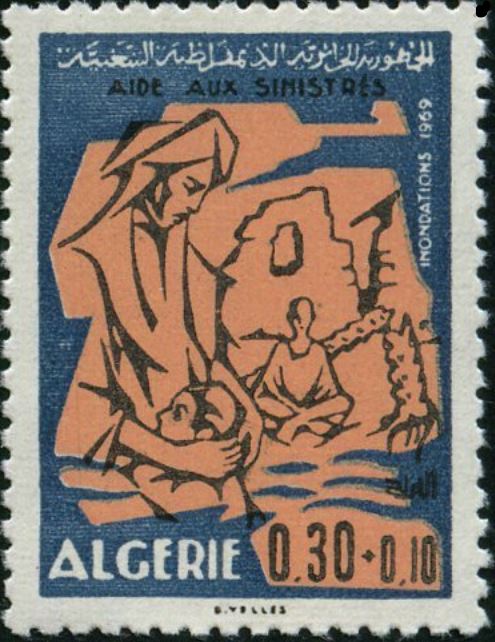
Disaster Assistance - Floods of 1969
A natural disaster has just struck three wilayas in the country: Titteri, Oasis and Aurès. Torrential rains of rare violence have excessively swollen wadis that have been dry for several decades.
These wadis, when leaving their bed, flooded, destroyed and devastated everything in their path, forming in places real inland seas. The first figures reveal the full extent of the disaster in the affected regions. They reflect the seriousness of the situation and make concretely perceptible the drama that has unfolded in recent days.
Dozens of dead, hundreds of injured, twenty thousand homes destroyed, one hundred thousand homeless, crops completely destroyed, bridges swept away, roads and railways cut. These are, according to initial estimates, the immense losses that the torrential rains and rolling floods caused in a few days.
Behind these figures, it is the poverty that hits these victims that we must remember. The farmer from Aurès, the shepherd from Titteri and the worker from Oasis have lost everything. The fruit of a whole year of hard work was wiped out by the destructive waters. For many, there is nothing left, neither house, nor plantations, nor animals. Nothing left but life in the middle of a devastated world. In a word, desolation.
Men, women, children and old people are waiting for help from us. Hunger, cold, illness have become their daily lot. The authorities have adopted the immediately necessary emergency measures and decided on a vast long-term program to completely redress the situation in the affected wilayas.
Adding to the effort of the State, that of everyone will have to materialize, expressing their solidarity. Faced with a tragedy of such magnitude, who could remain indifferent? In order to encourage everyone to help within their means, two postage stamps with surcharge have been issued. For their part, the affected populations will prove themselves worthy of this outpouring of solidarity, by rejecting all discouragement, and will respond to the call for mobilization to be at the forefront of reconstruction so that one day the disaster will be nothing more than a bad memory.
These wadis, when leaving their bed, flooded, destroyed and devastated everything in their path, forming in places real inland seas. The first figures reveal the full extent of the disaster in the affected regions. They reflect the seriousness of the situation and make concretely perceptible the drama that has unfolded in recent days.
Dozens of dead, hundreds of injured, twenty thousand homes destroyed, one hundred thousand homeless, crops completely destroyed, bridges swept away, roads and railways cut. These are, according to initial estimates, the immense losses that the torrential rains and rolling floods caused in a few days.
Behind these figures, it is the poverty that hits these victims that we must remember. The farmer from Aurès, the shepherd from Titteri and the worker from Oasis have lost everything. The fruit of a whole year of hard work was wiped out by the destructive waters. For many, there is nothing left, neither house, nor plantations, nor animals. Nothing left but life in the middle of a devastated world. In a word, desolation.
Men, women, children and old people are waiting for help from us. Hunger, cold, illness have become their daily lot. The authorities have adopted the immediately necessary emergency measures and decided on a vast long-term program to completely redress the situation in the affected wilayas.
Adding to the effort of the State, that of everyone will have to materialize, expressing their solidarity. Faced with a tragedy of such magnitude, who could remain indifferent? In order to encourage everyone to help within their means, two postage stamps with surcharge have been issued. For their part, the affected populations will prove themselves worthy of this outpouring of solidarity, by rejecting all discouragement, and will respond to the call for mobilization to be at the forefront of reconstruction so that one day the disaster will be nothing more than a bad memory.