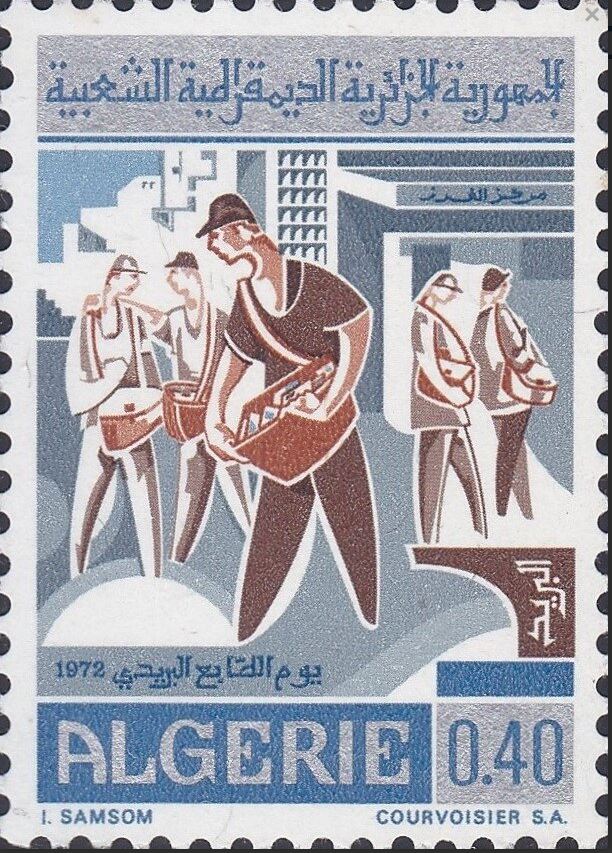
Stamp Day 1972
Among the multiple operations carried out by the services of the Post and Telecommunications Administration, home postal delivery is one of the most important and, without doubt, the best known to the public.
Who does not know, having at least seen him in the exercise of his duties, the distributor attendant commonly called “postman”. This uniformed agent, who can be encountered in town or in the countryside, brings the expected letter, package or newspaper every day, whatever the weather.
More than 1,600 distributors leave every morning from the 970 post offices located throughout the national territory. In large and medium-sized towns, home delivery is provided twice a day. Tours are carried out either on foot or using a mount or mechanical means such as bicycles, motorcycles and vans.
This is how 124 million objects of all categories are distributed annually. The number of agents assigned to this service, although significant, however only represents a part of the overall administration staff, because the object deposited at the counter of a post office or in a mailbox undergoes multiple handling before being classified in the attendant's bag and put out for distribution.
Indeed, in addition to postmen and counter attendants, there is a large category of employees who work day and night to receive, sort, route and finally prepare this distribution. These are the tasks carried out 24 hours a day by the agents of the Algiers Sorting and Distribution Center. This functional establishment equipped with modern mechanical handling installations covers an area of 2,880 m2 near the platforms and a short distance from the Algiers railway station. In addition to its functions as the capital's distribution center, this office also plays an important role in both national and international trade.
This unique complex has a total workforce of 700 units, including 180 distributors, to process on average 300,000 various objects per day, including 50,000 for distribution. This brief description of one of the responsibilities of the postal services obviously only gives a small overview of the human and material resources implemented by the Post and Telecommunications Administration to get closer to users. It can nevertheless give an idea of the role that the PTT plays in the country's economic and social development policy.
Who does not know, having at least seen him in the exercise of his duties, the distributor attendant commonly called “postman”. This uniformed agent, who can be encountered in town or in the countryside, brings the expected letter, package or newspaper every day, whatever the weather.
More than 1,600 distributors leave every morning from the 970 post offices located throughout the national territory. In large and medium-sized towns, home delivery is provided twice a day. Tours are carried out either on foot or using a mount or mechanical means such as bicycles, motorcycles and vans.
This is how 124 million objects of all categories are distributed annually. The number of agents assigned to this service, although significant, however only represents a part of the overall administration staff, because the object deposited at the counter of a post office or in a mailbox undergoes multiple handling before being classified in the attendant's bag and put out for distribution.
Indeed, in addition to postmen and counter attendants, there is a large category of employees who work day and night to receive, sort, route and finally prepare this distribution. These are the tasks carried out 24 hours a day by the agents of the Algiers Sorting and Distribution Center. This functional establishment equipped with modern mechanical handling installations covers an area of 2,880 m2 near the platforms and a short distance from the Algiers railway station. In addition to its functions as the capital's distribution center, this office also plays an important role in both national and international trade.
This unique complex has a total workforce of 700 units, including 180 distributors, to process on average 300,000 various objects per day, including 50,000 for distribution. This brief description of one of the responsibilities of the postal services obviously only gives a small overview of the human and material resources implemented by the Post and Telecommunications Administration to get closer to users. It can nevertheless give an idea of the role that the PTT plays in the country's economic and social development policy.