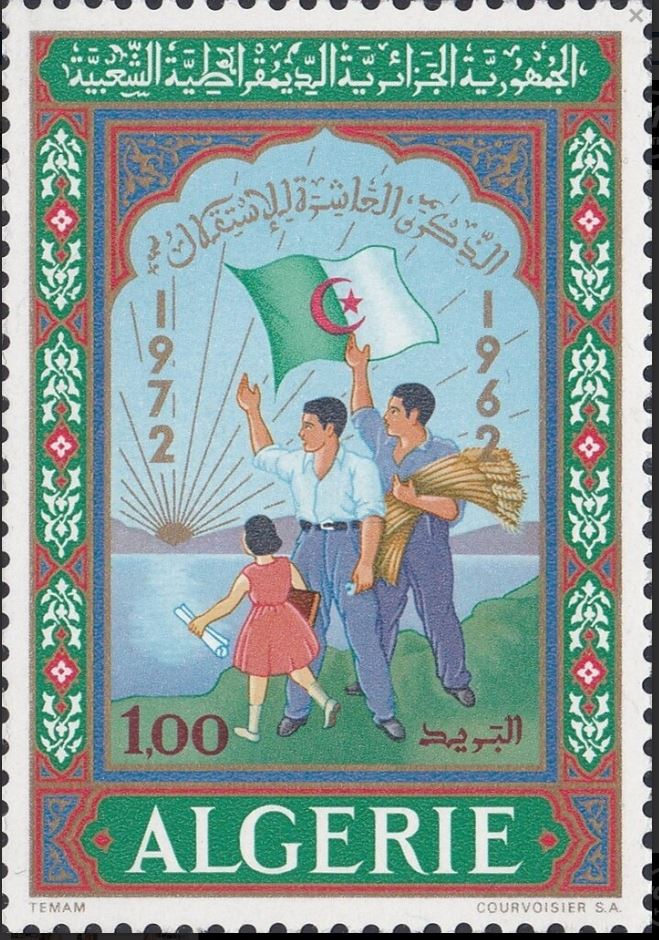
10th Anniversary of Independence
Algeria celebrates the 10th anniversary of its independence. This ten-year period will remain a decisive stage in history for a young nation which, from the outset, made clear its desire to join the ranks of industrialized countries as quickly as possible, without denying any of its principles of sovereignty and freedom. The journey has not been without difficulty.
July 5, 1962
Algeria gains independence. A glorious people, bruised by more than seven years of war, takes the reins of their destiny. While bandaging his wounds... He embarks on a great work of edification. The paltry number of available executives gives an overwhelming character to the enterprise, especially since the people, at the start, know practically nothing of the problems of economic management from which they were excluded during 132 years of colonization.
July 5, 1972
Ten years later, Algeria shows the world the face of a nation in full economic expansion whose sound management is recognized by all experts. Transformed into a vast construction site by the four-year plan, master of all its natural resources and advantaged by the stability of political life, Algeria today is in the leading group of countries undergoing industrialization. To achieve this result, it took great faith, that of believing in the maxim “The Revolution by the people and for the people”.
Diverted for a moment from this objective, the Algerian Revolution was to resume its normal course following the recovery of June 19, 1965, the date which marks the beginning of considered action. Gradually, in fact, the State mastered the different sectors of the national economy, before ensuring control (banks, mines, processing industries, maritime transport and, more recently, oil resources, an unprecedented event in the history of the Third World). All of these sectors have undergone a profound transformation following the application of the pre-plan and the four-year plan. In addition to planned operations, there are special development programs for the most deprived regions, because one of the requirements of the Algerian Revolution is to ensure harmonious social promotion throughout the country.
To encourage this action, administrative decentralization was carried out. The schooling effort has been developed from year to year. The number of students in school has almost quadrupled, going from 700,000 to 2,500,000. The Arabic language has regained its rights. The self-managed agricultural sector, which brings together all the lands of the former settlers, has been modernized and new cultivation methods introduced. All these actions fit into the triptych: Agrarian Revolution – Industrial Revolution – Cultural Revolution.
More than a redistribution of land currently being implemented, the Agrarian Revolution aims to organize model agricultural villages, bringing together the conditions for a new life. Already for a year, and for the first time, agricultural workers have been provided with a social security system and family allowances. The Industrial Revolution tends to make the worker a producer fully associated with the socialist management of businesses. A new concept, the Cultural Revolution is marked by the effort of Arabization, schooling, renewal of training methods (promotion of technology institutes), construction of cultural centers, etc.
To recover all its rights and manage the national economy in its own way, Algeria needed an attitude of perseverance and firmness, two qualities with which President Boumediène conducted the affairs of the State. At independence, Algeria demonstrated its desire to build an economy based on the exploitation of its own resources. Today, the echoes of the recent UNCTAD conference bring deep resonance to this judgment.
July 5, 1962
Algeria gains independence. A glorious people, bruised by more than seven years of war, takes the reins of their destiny. While bandaging his wounds... He embarks on a great work of edification. The paltry number of available executives gives an overwhelming character to the enterprise, especially since the people, at the start, know practically nothing of the problems of economic management from which they were excluded during 132 years of colonization.
July 5, 1972
Ten years later, Algeria shows the world the face of a nation in full economic expansion whose sound management is recognized by all experts. Transformed into a vast construction site by the four-year plan, master of all its natural resources and advantaged by the stability of political life, Algeria today is in the leading group of countries undergoing industrialization. To achieve this result, it took great faith, that of believing in the maxim “The Revolution by the people and for the people”.
Diverted for a moment from this objective, the Algerian Revolution was to resume its normal course following the recovery of June 19, 1965, the date which marks the beginning of considered action. Gradually, in fact, the State mastered the different sectors of the national economy, before ensuring control (banks, mines, processing industries, maritime transport and, more recently, oil resources, an unprecedented event in the history of the Third World). All of these sectors have undergone a profound transformation following the application of the pre-plan and the four-year plan. In addition to planned operations, there are special development programs for the most deprived regions, because one of the requirements of the Algerian Revolution is to ensure harmonious social promotion throughout the country.
To encourage this action, administrative decentralization was carried out. The schooling effort has been developed from year to year. The number of students in school has almost quadrupled, going from 700,000 to 2,500,000. The Arabic language has regained its rights. The self-managed agricultural sector, which brings together all the lands of the former settlers, has been modernized and new cultivation methods introduced. All these actions fit into the triptych: Agrarian Revolution – Industrial Revolution – Cultural Revolution.
More than a redistribution of land currently being implemented, the Agrarian Revolution aims to organize model agricultural villages, bringing together the conditions for a new life. Already for a year, and for the first time, agricultural workers have been provided with a social security system and family allowances. The Industrial Revolution tends to make the worker a producer fully associated with the socialist management of businesses. A new concept, the Cultural Revolution is marked by the effort of Arabization, schooling, renewal of training methods (promotion of technology institutes), construction of cultural centers, etc.
To recover all its rights and manage the national economy in its own way, Algeria needed an attitude of perseverance and firmness, two qualities with which President Boumediène conducted the affairs of the State. At independence, Algeria demonstrated its desire to build an economy based on the exploitation of its own resources. Today, the echoes of the recent UNCTAD conference bring deep resonance to this judgment.