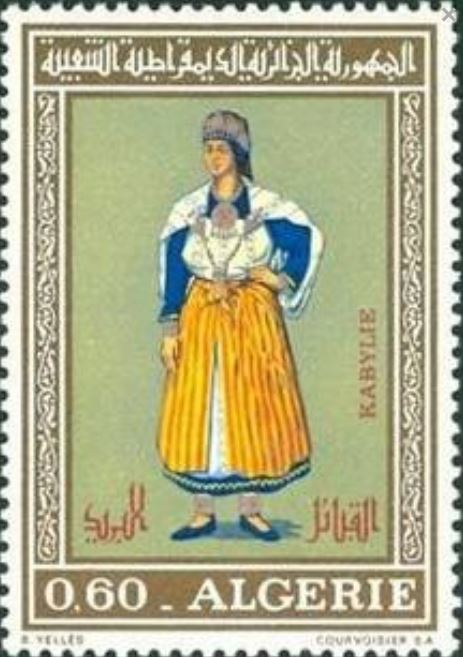
Kabylia costume
Traditional costume in Algeria is most often the reflection of multiple cultural influences. Whether Berber, Arab, Andalusian, Ottoman or European, the clothing inspirations have followed one another and embraced, in refinement and elegance, Algerian values.
Over time and up to the present day, traditional costumes dress the body in a harmonious mix of velvet, silk, satin and brocade, enhanced with rich gold or silver jewelry depending on the region.
In Kabylia, traditional clothing is still worn in daily life. Adapted to the relief and climate of the region, it allows very active women in the villages a certain ease of movement during their daily work.
The djebba, the belt and the fouta decorated with multicolored braids constitute the main pieces of women's clothing.
In the Hoggar, the traditional costume is reminiscent of the African costume and comes, for men, in the form of tunics and wide pants decorated with majestic headdresses made of turbans of different lengths including a minimum of six meters of indigo fabric which gives the Tuareg the nickname blue men.
The traditional costume of men in Algeria reveals many similarities from one region to another. The men of the M'zab mainly wear wide-seated white fabric pants, a very simple gandoura, a chechia, a turban and a burnous.
In Tlemcen, the female costume is very rich and is made up of superpositions of clothing pieces which give the woman unparalleled presence. Dress of silk and gold thread, fouta m'taqla which surrounds the waist, richly embroidered velvet caftan are the main pieces of the outfit. This is enhanced by the ‘abrouk which adorns the chest for the height of refinement.
Over time and up to the present day, traditional costumes dress the body in a harmonious mix of velvet, silk, satin and brocade, enhanced with rich gold or silver jewelry depending on the region.
In Kabylia, traditional clothing is still worn in daily life. Adapted to the relief and climate of the region, it allows very active women in the villages a certain ease of movement during their daily work.
The djebba, the belt and the fouta decorated with multicolored braids constitute the main pieces of women's clothing.
In the Hoggar, the traditional costume is reminiscent of the African costume and comes, for men, in the form of tunics and wide pants decorated with majestic headdresses made of turbans of different lengths including a minimum of six meters of indigo fabric which gives the Tuareg the nickname blue men.
The traditional costume of men in Algeria reveals many similarities from one region to another. The men of the M'zab mainly wear wide-seated white fabric pants, a very simple gandoura, a chechia, a turban and a burnous.
In Tlemcen, the female costume is very rich and is made up of superpositions of clothing pieces which give the woman unparalleled presence. Dress of silk and gold thread, fouta m'taqla which surrounds the waist, richly embroidered velvet caftan are the main pieces of the outfit. This is enhanced by the ‘abrouk which adorns the chest for the height of refinement.