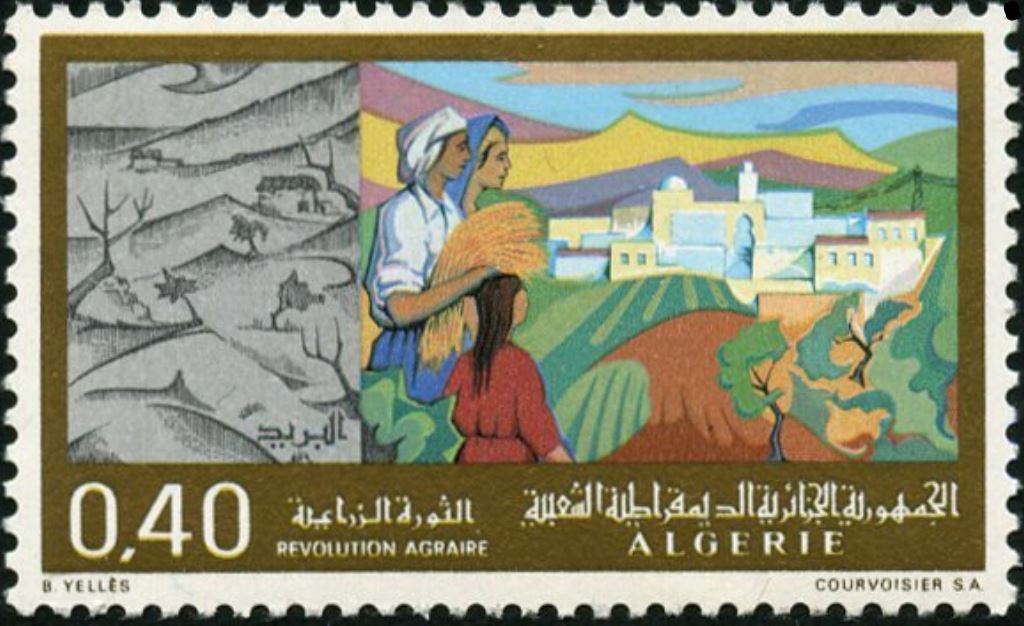
Agrarian Revolution
At the beginning of colonization, peasant struggles against dispossession and land grabbing were identified with popular resistance against colonial penetration and control. This struggle took on an increasingly acute character because the Algerian people found themselves confronted with an enterprise of dispossession that was as totalitarian in its means as in its goals.
Indeed, colonial policy was not limited to a simple action of land appropriation. Beyond this objective, it aimed to break popular resistance to the occupier by undermining the foundations of the organization of Algerian society through the destruction of its economic and cultural base. Prior to the conquest, the mode of collective tenure which predominated in agriculture reflected the organization of society. The annihilation of collective land and the brutal dispersion of peasant communities should, therefore, open the way to the dislocation of agrarian structures and of rural society as a whole.
The culmination of a centuries-old struggle, the appeal of November 1, 1954 had to respond, therefore, to the deep aspirations of the working masses of the countryside: the peasants massively joined the ranks of the National Liberation Army (ALN) which was made up in the vast majority of fighters from our countryside.
In this context, the struggle for independence was closely associated with the unanimous desire to build a new society that was just and open to all, but which prioritized the dignity of workers. National independence and the recovery of national wealth thus resulted, in a first stage, in the recovery of settlers' lands for the benefit of workers who then became producers, in accordance with the socialist orientation of the country.
The second stage of the Agrarian Revolution is that which applies to properties and agricultural operations owned by nationals and communities. This second stage appears to be the most important, since it must result not in a simple nationalization of land, but in the creation of the conditions for their development for the benefit of the rural masses long kept on the margins of progress and in the service of their cultural, economic and social promotion. This is why the Agrarian Revolution, beyond simple concerns of social justice, signifies the radical transformation of living and working conditions in the rural world.
To truly be the fundamental element of progress for the most deprived masses, the Agrarian Revolution must provide them with all the factors of progress. This is why it associates the redistribution of land with the organization of farmers and the establishment of conditions for their promotion. If it allows the promotion of the farmer, the Agrarian Revolution nonetheless defines his obligations towards the national community by imposing on him the full development of the means of production at his disposal.
The Agrarian Revolution, through dual action at the level of relations and structures of production, can and must reverse the process of concentration of land ownership and liquidate the last after-effects of colonization whose consequences, such as the rural exodus and the worsening of economic and cultural disparities between the cities and the countryside, go against the country's development strategy. A historical task, the Agrarian Revolution must achieve the fundamental object of the Socialist Revolution which is to promote the dignity of all through work. It is therefore a question of eliminating all forms of exploitation of the labor of others by re-establishing direct labor relations in agriculture based on the principle “The land belongs to those who work it”.
This overhaul of agrarian structures is itself part of coordinated action on all the conditions which determine agricultural activity and life in the countryside. The Agrarian Revolution must truly constitute a new beginning for the peasant masses, thanks to global, coherent and continuous action on the human and material factors which block their progress and promotion.
Extract from the charter of the Agrarian Revolution.
Indeed, colonial policy was not limited to a simple action of land appropriation. Beyond this objective, it aimed to break popular resistance to the occupier by undermining the foundations of the organization of Algerian society through the destruction of its economic and cultural base. Prior to the conquest, the mode of collective tenure which predominated in agriculture reflected the organization of society. The annihilation of collective land and the brutal dispersion of peasant communities should, therefore, open the way to the dislocation of agrarian structures and of rural society as a whole.
The culmination of a centuries-old struggle, the appeal of November 1, 1954 had to respond, therefore, to the deep aspirations of the working masses of the countryside: the peasants massively joined the ranks of the National Liberation Army (ALN) which was made up in the vast majority of fighters from our countryside.
In this context, the struggle for independence was closely associated with the unanimous desire to build a new society that was just and open to all, but which prioritized the dignity of workers. National independence and the recovery of national wealth thus resulted, in a first stage, in the recovery of settlers' lands for the benefit of workers who then became producers, in accordance with the socialist orientation of the country.
The second stage of the Agrarian Revolution is that which applies to properties and agricultural operations owned by nationals and communities. This second stage appears to be the most important, since it must result not in a simple nationalization of land, but in the creation of the conditions for their development for the benefit of the rural masses long kept on the margins of progress and in the service of their cultural, economic and social promotion. This is why the Agrarian Revolution, beyond simple concerns of social justice, signifies the radical transformation of living and working conditions in the rural world.
To truly be the fundamental element of progress for the most deprived masses, the Agrarian Revolution must provide them with all the factors of progress. This is why it associates the redistribution of land with the organization of farmers and the establishment of conditions for their promotion. If it allows the promotion of the farmer, the Agrarian Revolution nonetheless defines his obligations towards the national community by imposing on him the full development of the means of production at his disposal.
The Agrarian Revolution, through dual action at the level of relations and structures of production, can and must reverse the process of concentration of land ownership and liquidate the last after-effects of colonization whose consequences, such as the rural exodus and the worsening of economic and cultural disparities between the cities and the countryside, go against the country's development strategy. A historical task, the Agrarian Revolution must achieve the fundamental object of the Socialist Revolution which is to promote the dignity of all through work. It is therefore a question of eliminating all forms of exploitation of the labor of others by re-establishing direct labor relations in agriculture based on the principle “The land belongs to those who work it”.
This overhaul of agrarian structures is itself part of coordinated action on all the conditions which determine agricultural activity and life in the countryside. The Agrarian Revolution must truly constitute a new beginning for the peasant masses, thanks to global, coherent and continuous action on the human and material factors which block their progress and promotion.
Extract from the charter of the Agrarian Revolution.