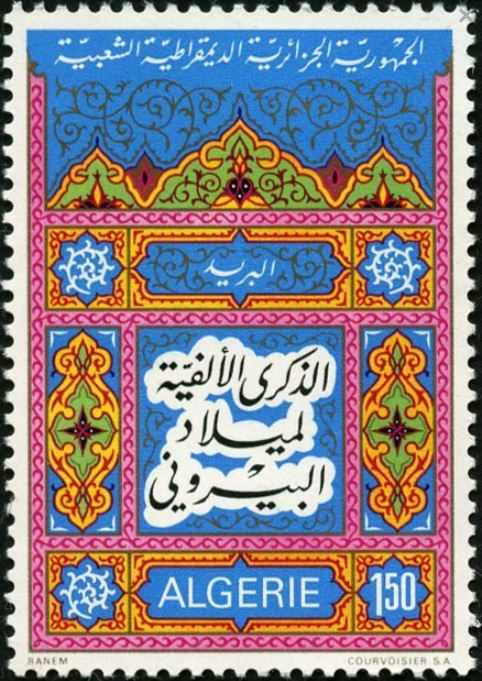
Millennium of the Birth of El Biruni (973-1051)
In the 3rd century AH (9th century CE), the Baghdad school produced the most famous scholars in the world of Islam.
These great scholars, whose influence extended throughout the Muslim world, as well as Central Asia, India and China, were very great workers, interested in all the sciences of the time.
Al Biruni was one of them. This great intellectual personality, observer and curious mind dealt with almost all sciences: philosophy, history, linguistics, poetry, mathematics, physical and natural sciences, astronomy and finally geography.
Abou Rayhan Mohamed Al Biruni, whose millennium is being celebrated in several countries, was born to an Iranian family in 362 AH (973 CE), in one of the suburbs (Beroum, hence his nickname Al Biruni) of Khawarizm. He received a very advanced scientific education from a young age.
Al Biruni was subsequently received at the court of the prince of Djourdjan where he stayed for a long time. He dedicated his first major work to this prince: a chronology dealing with important mathematical, astronomical, meteorological problems, etc.
Al Biruni subsequently stayed for seven years in the court of Prince Khwarimshah Abu Al Abbas Ma'moum. At the time of the conquest of the country by the Gaznarite Sultan, Al Biruni was taken to Gazna, Afghanistan.
Al Biruni's qualities kept him in the court of Gazna as an astrologer. The sultan, who became his protector, even took him as his main companion during his expeditions to India. It was at this time that Al Biruni's wanderings began, first in India and then across several countries.
His long stay in India allowed him to learn the Indian language, which facilitated his contact with the greatest scholars of this country. He exchanged with them the knowledge of the Baghdad school for that of India.
This stay in India allowed Al Biruni to bring together, on his return to Afghanistan, all the knowledge he had acquired in his work entitled Tarikh Al Hind (history of India).
After this trip, Al Biruni settled at the court of Gazna, near Sultan Massoud to whom he dedicated his third main work entitled Qanoun Al Massoudi, a complete treatise on astronomy.
In the same year, Al Biruni composed his Kitab attaf’him, a work of geometry, arithmetic, astronomy and astrology. Al Biruni's work was considerable. According to some historians, it counts among the 180 titles, most of them written in Arabic, some simultaneously in Arabic and Persian.
His main works were published and translated into English and German. Al Biruni, this great worker, was not only concerned with exposing new ideas, but he expressed himself in very beautiful prose and only left his pen with his last breath.
A contemporary scholar of Al Biruni entering his home, when he was already in agony, recounts: "Al Biruni said to me: 'You one day spoke to me about the problem of defective ancestors (problem about the sharing of inheritances).' I tried to say a few words of pity to him about his condition, but the dying man replied: 'Is it not better that I leave the world knowing the solution to this problem than to leave it without knowing it.' I then repeated the question to him and he gave me the solution he had once promised me. A few moments later, the great scholar breathed his last.”
These great scholars, whose influence extended throughout the Muslim world, as well as Central Asia, India and China, were very great workers, interested in all the sciences of the time.
Al Biruni was one of them. This great intellectual personality, observer and curious mind dealt with almost all sciences: philosophy, history, linguistics, poetry, mathematics, physical and natural sciences, astronomy and finally geography.
Abou Rayhan Mohamed Al Biruni, whose millennium is being celebrated in several countries, was born to an Iranian family in 362 AH (973 CE), in one of the suburbs (Beroum, hence his nickname Al Biruni) of Khawarizm. He received a very advanced scientific education from a young age.
Al Biruni was subsequently received at the court of the prince of Djourdjan where he stayed for a long time. He dedicated his first major work to this prince: a chronology dealing with important mathematical, astronomical, meteorological problems, etc.
Al Biruni subsequently stayed for seven years in the court of Prince Khwarimshah Abu Al Abbas Ma'moum. At the time of the conquest of the country by the Gaznarite Sultan, Al Biruni was taken to Gazna, Afghanistan.
Al Biruni's qualities kept him in the court of Gazna as an astrologer. The sultan, who became his protector, even took him as his main companion during his expeditions to India. It was at this time that Al Biruni's wanderings began, first in India and then across several countries.
His long stay in India allowed him to learn the Indian language, which facilitated his contact with the greatest scholars of this country. He exchanged with them the knowledge of the Baghdad school for that of India.
This stay in India allowed Al Biruni to bring together, on his return to Afghanistan, all the knowledge he had acquired in his work entitled Tarikh Al Hind (history of India).
After this trip, Al Biruni settled at the court of Gazna, near Sultan Massoud to whom he dedicated his third main work entitled Qanoun Al Massoudi, a complete treatise on astronomy.
In the same year, Al Biruni composed his Kitab attaf’him, a work of geometry, arithmetic, astronomy and astrology. Al Biruni's work was considerable. According to some historians, it counts among the 180 titles, most of them written in Arabic, some simultaneously in Arabic and Persian.
His main works were published and translated into English and German. Al Biruni, this great worker, was not only concerned with exposing new ideas, but he expressed himself in very beautiful prose and only left his pen with his last breath.
A contemporary scholar of Al Biruni entering his home, when he was already in agony, recounts: "Al Biruni said to me: 'You one day spoke to me about the problem of defective ancestors (problem about the sharing of inheritances).' I tried to say a few words of pity to him about his condition, but the dying man replied: 'Is it not better that I leave the world knowing the solution to this problem than to leave it without knowing it.' I then repeated the question to him and he gave me the solution he had once promised me. A few moments later, the great scholar breathed his last.”