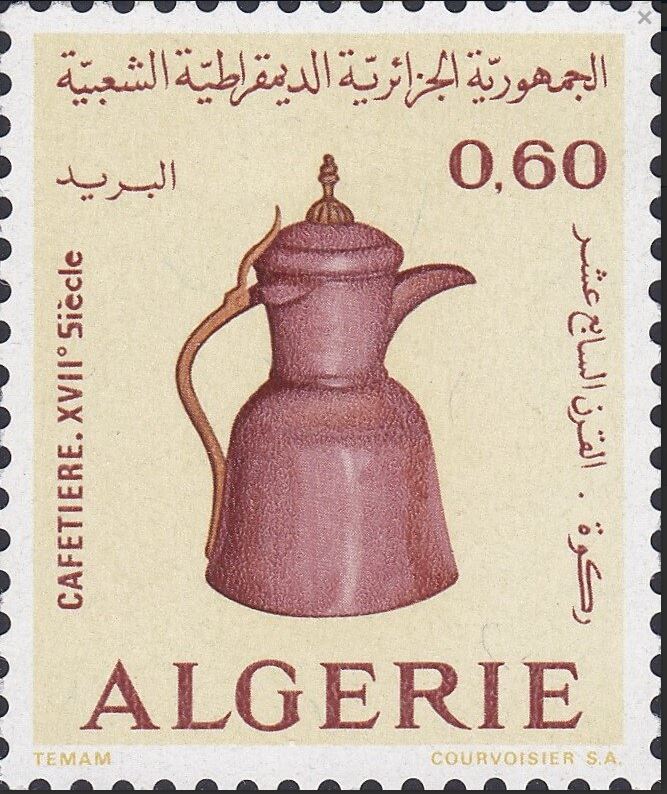
17th century coffee maker
Algerian brassware boomed in the 17th century. The National Museum of Antiquities in Algiers has a very beautiful collection of coppers characterized by their floral motifs.
Algiers was the main manufacturing center; we also cite Boussaâda, Boghar and Laghouat. In Constantine, old techniques are still in the spotlight.
Sitting in front of their easels, the coppersmiths model the vases to the rhythm of the hammer blows. Commonly, the decoration was traced with a chisel and hatched with parallel lines.
Regrowth by sandblasting of the funds appears very rarely. The containers were numerous and of very varied shapes: measures used for the distribution of the obligatory alms at the start of the Eid El Fitr celebrations, basins for the Moorish bath, cauldrons, double-bottomed hand wash basins for ablutions, oriental-shaped ewers resting on an openwork support in their basin and incense burners.
The kitchenware consisted of trays, kettles, teapots, coffee pots, pots, dishes, couscous pots and sugar bowls. These latter objects most often had the bottom decorated with gadroons and the lid with pushed diamond points.
This kitchenware was frequently tin-plated and even silver-plated. Through their oriental-inspired shape, all these pieces are reminiscent of Turkish and Persian brassware, but often feature decorative motifs of ancient local inspiration.
Algiers was the main manufacturing center; we also cite Boussaâda, Boghar and Laghouat. In Constantine, old techniques are still in the spotlight.
Sitting in front of their easels, the coppersmiths model the vases to the rhythm of the hammer blows. Commonly, the decoration was traced with a chisel and hatched with parallel lines.
Regrowth by sandblasting of the funds appears very rarely. The containers were numerous and of very varied shapes: measures used for the distribution of the obligatory alms at the start of the Eid El Fitr celebrations, basins for the Moorish bath, cauldrons, double-bottomed hand wash basins for ablutions, oriental-shaped ewers resting on an openwork support in their basin and incense burners.
The kitchenware consisted of trays, kettles, teapots, coffee pots, pots, dishes, couscous pots and sugar bowls. These latter objects most often had the bottom decorated with gadroons and the lid with pushed diamond points.
This kitchenware was frequently tin-plated and even silver-plated. Through their oriental-inspired shape, all these pieces are reminiscent of Turkish and Persian brassware, but often feature decorative motifs of ancient local inspiration.