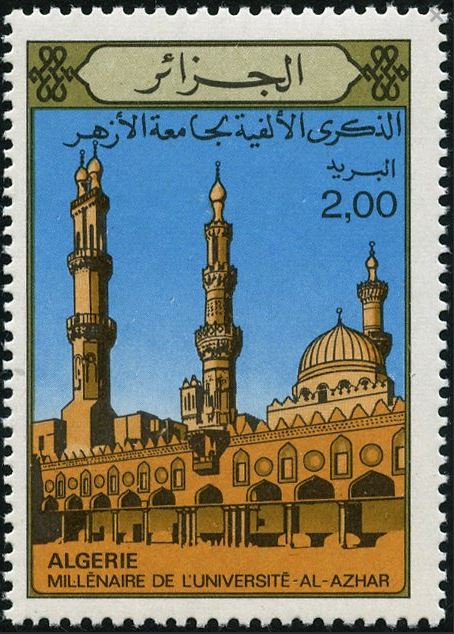
Millennium of Al Azhar University
Founded by Djawhar, the Sicilian chief, on the orders of his master the caliph Al Mou'iz Lidin Allah, during the years 359-361 AH (970-972) to serve as both a mosque and a school, Al Azhar was the first of the mosques built by the Fatimids. Its name goes back to Fatima Azzahra, daughter of the Prophet (QSSSL).
In its current appearance, the University of Al Azhar with its three minarets is made up of a set of structures and expansions carried out through different eras. Among the parts that make it up, we especially notice the large prayer room supported by columns and opening onto a vast courtyard (sahn) furnished with porticos of plastered architectural ornamentation in the Fatimid style, applied like a tapestry on the surface to be decorated and surrounded by Kufic calligraphy.
Considered one of the oldest Islamic universities, Al Azhar offered the first course in 364 AH (975). From then on, it remained the asylum of Arab-Islamic cultures and one of the main sources of intellectual movement in the Islamic world.
As a scientific university, Al Azhar comprises five periods. The period of the Fatimids, its founders, where it experienced its true university life when the caliph Al Aziz Billah allowed his minister Yaâkoub Ibn Kels to appoint a group of doctors to provide teaching in different disciplines, notably the sciences of the Koran, hadith, jurisprudence as well as mathematics and medicine.
With the Ayyubid era, it retained its university character, but lost its cultural function. The office of Friday prayer was no longer celebrated for a century.
Then intellectual life experienced a dazzling flourishing under the reign of the Mamluks. Many students came from all over the world to learn there. At the beginning of the 7th century AH, Al Azhar assumed a great historical mission by preserving the heritage of Arab-Islamic civilization from the Mongol devastations in the East which spared neither the science institutes of Baghdad nor the sources of Islamic culture in Spain.
Al Azhar thus became the refuge of scholars and students and allowed a group of famous men of science, such as Ibn Khaldoun, Omar Ibn Al Faredh, Ibn Khalikane Al Askalani, Al Mekrizi and many others, to find an ideal place for their intellectual activities.
But during the Ottoman era, education experienced a decline which intensified at the beginning of the 19th century under the reign of Mohammed Ali. The teaching programs were limited to religious and linguistic sciences only until the eve of the fundamental overhaul of 1961 which allowed the University of Al Azhar to shine again and extend its cultural activity to all scientific disciplines.
In its current appearance, the University of Al Azhar with its three minarets is made up of a set of structures and expansions carried out through different eras. Among the parts that make it up, we especially notice the large prayer room supported by columns and opening onto a vast courtyard (sahn) furnished with porticos of plastered architectural ornamentation in the Fatimid style, applied like a tapestry on the surface to be decorated and surrounded by Kufic calligraphy.
Considered one of the oldest Islamic universities, Al Azhar offered the first course in 364 AH (975). From then on, it remained the asylum of Arab-Islamic cultures and one of the main sources of intellectual movement in the Islamic world.
As a scientific university, Al Azhar comprises five periods. The period of the Fatimids, its founders, where it experienced its true university life when the caliph Al Aziz Billah allowed his minister Yaâkoub Ibn Kels to appoint a group of doctors to provide teaching in different disciplines, notably the sciences of the Koran, hadith, jurisprudence as well as mathematics and medicine.
With the Ayyubid era, it retained its university character, but lost its cultural function. The office of Friday prayer was no longer celebrated for a century.
Then intellectual life experienced a dazzling flourishing under the reign of the Mamluks. Many students came from all over the world to learn there. At the beginning of the 7th century AH, Al Azhar assumed a great historical mission by preserving the heritage of Arab-Islamic civilization from the Mongol devastations in the East which spared neither the science institutes of Baghdad nor the sources of Islamic culture in Spain.
Al Azhar thus became the refuge of scholars and students and allowed a group of famous men of science, such as Ibn Khaldoun, Omar Ibn Al Faredh, Ibn Khalikane Al Askalani, Al Mekrizi and many others, to find an ideal place for their intellectual activities.
But during the Ottoman era, education experienced a decline which intensified at the beginning of the 19th century under the reign of Mohammed Ali. The teaching programs were limited to religious and linguistic sciences only until the eve of the fundamental overhaul of 1961 which allowed the University of Al Azhar to shine again and extend its cultural activity to all scientific disciplines.