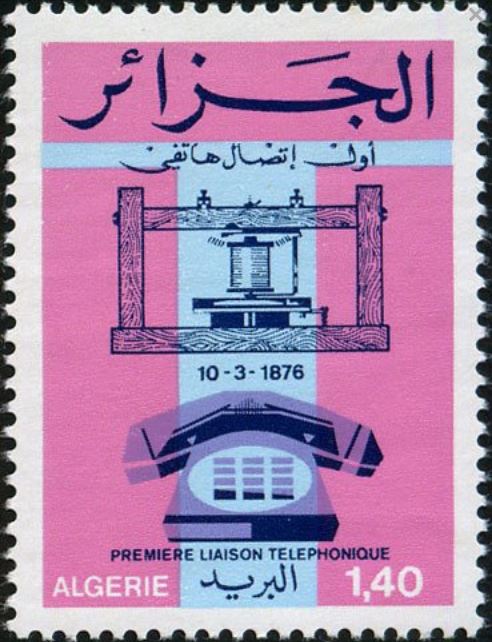
Centenary of the First Telephone Connection
The transmission of the human voice via electricity responded to the need to exchange a large volume of information. The telephone was developed by some physicists.
It was Philipp Reis who achieved, in 1860, the first electrical transmission of a melody over a certain distance. Around 1875, Elisha Gray and Alexander Graham Bell, who did not know each other, devoted themselves separately to telephone transmissions.
Gray's phone looked like Reis's. Gray had attached a small steel rod to the membrane, the end of which dipped into a liquid of low conductivity.
Any sound emitted in front of the membrane caused the rod to vibrate, resulting in a variation of the current in the circuit powered by accumulators of which this liquid was a part.
At the receiving station, the conductors passed through an electromagnet inside which was placed another soft iron rod also attached to a membrane. Thus, the sound reaching the transmitting diaphragm was electrically reproduced by the receiving diaphragm.
On February 14, 1876, Gray filed a provisional patent application for the instrument he had invented, while on the same day, but a few hours earlier, Bell had filed a patent for the same type of instrument.
The authorship of the invention was the subject of bitter legal disputes, but it was Bell who ultimately received the patent rights for an invention that gave him great prestige.
These primitive devices only allowed mediocre communications, but they progressed very quickly. It was on March 10, 1876 and after many attempts that Bell uttered a complete sentence on the telephone. His correspondent, Mr. Watson, was his own assistant.
As early as 1877, the installation of a telephone line was carried out. That same year, a newsletter was sent by telephone to a newspaper. This feat marked the beginning of the public use of the telephone. This means of communication would experience remarkable expansion in all parts of the world where there are approximately 350 million telephone sets in service.
It was Philipp Reis who achieved, in 1860, the first electrical transmission of a melody over a certain distance. Around 1875, Elisha Gray and Alexander Graham Bell, who did not know each other, devoted themselves separately to telephone transmissions.
Gray's phone looked like Reis's. Gray had attached a small steel rod to the membrane, the end of which dipped into a liquid of low conductivity.
Any sound emitted in front of the membrane caused the rod to vibrate, resulting in a variation of the current in the circuit powered by accumulators of which this liquid was a part.
At the receiving station, the conductors passed through an electromagnet inside which was placed another soft iron rod also attached to a membrane. Thus, the sound reaching the transmitting diaphragm was electrically reproduced by the receiving diaphragm.
On February 14, 1876, Gray filed a provisional patent application for the instrument he had invented, while on the same day, but a few hours earlier, Bell had filed a patent for the same type of instrument.
The authorship of the invention was the subject of bitter legal disputes, but it was Bell who ultimately received the patent rights for an invention that gave him great prestige.
These primitive devices only allowed mediocre communications, but they progressed very quickly. It was on March 10, 1876 and after many attempts that Bell uttered a complete sentence on the telephone. His correspondent, Mr. Watson, was his own assistant.
As early as 1877, the installation of a telephone line was carried out. That same year, a newsletter was sent by telephone to a newspaper. This feat marked the beginning of the public use of the telephone. This means of communication would experience remarkable expansion in all parts of the world where there are approximately 350 million telephone sets in service.