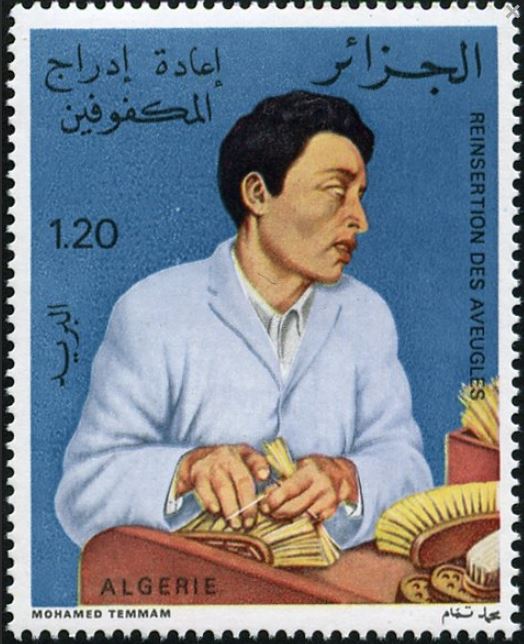
Reintegration of the Blind
Since the dawn of civilization, society has faced the problems of blindness, and the treatment reserved for the blind has continued to develop over the centuries.
Many scientists and researchers such as Hounaïn Ibn Is'haq, Roger Bacon, Antonij van Leeuwenhoek, René Descartes, Louis Braille and many others, exercising very diverse professions, living in different countries and at very distant times from each other, have focused on this health problem which is of particular importance in the world.
Finding remedies, adapting new prostheses, inventing replacement techniques to allow those affected by blindness to maintain or resume their active place in society remain one of the most necessary forms of this fight.
It is in this area, and more particularly that of prophylaxis, that the World Health Organization invites all nations to focus on the prevention of blindness.
Algeria has not failed to take part in this fight undertaken throughout our planet to prevent blindness. This is how it promulgated, upon its independence, a law on the social protection of the blind and founded for this purpose the National Organization of the Algerian Blind (ONAA) which has just celebrated its thirteenth anniversary.
Since then, the National Organization of the Algerian Blind has made great efforts to reintegrate the blind into social life by training switchboard operators and teachers and creating workshops. The Ministry of Public Health and Population takes a large part in this effort by creating schools for blind children, organizing school hygiene services, and developing the fight against trachoma every day, especially in the south of the country.
The campaign launched by the World Health Organization during the month of April 1976, under the theme “Predicting and preventing blindness” will certainly contribute to further protecting the eye. But despite the scientific and social progress that has been laboriously achieved, it is obvious that a lot of effort will still be needed to definitively eradicate this infirmity which handicaps millions of human beings.
Many scientists and researchers such as Hounaïn Ibn Is'haq, Roger Bacon, Antonij van Leeuwenhoek, René Descartes, Louis Braille and many others, exercising very diverse professions, living in different countries and at very distant times from each other, have focused on this health problem which is of particular importance in the world.
Finding remedies, adapting new prostheses, inventing replacement techniques to allow those affected by blindness to maintain or resume their active place in society remain one of the most necessary forms of this fight.
It is in this area, and more particularly that of prophylaxis, that the World Health Organization invites all nations to focus on the prevention of blindness.
Algeria has not failed to take part in this fight undertaken throughout our planet to prevent blindness. This is how it promulgated, upon its independence, a law on the social protection of the blind and founded for this purpose the National Organization of the Algerian Blind (ONAA) which has just celebrated its thirteenth anniversary.
Since then, the National Organization of the Algerian Blind has made great efforts to reintegrate the blind into social life by training switchboard operators and teachers and creating workshops. The Ministry of Public Health and Population takes a large part in this effort by creating schools for blind children, organizing school hygiene services, and developing the fight against trachoma every day, especially in the south of the country.
The campaign launched by the World Health Organization during the month of April 1976, under the theme “Predicting and preventing blindness” will certainly contribute to further protecting the eye. But despite the scientific and social progress that has been laboriously achieved, it is obvious that a lot of effort will still be needed to definitively eradicate this infirmity which handicaps millions of human beings.