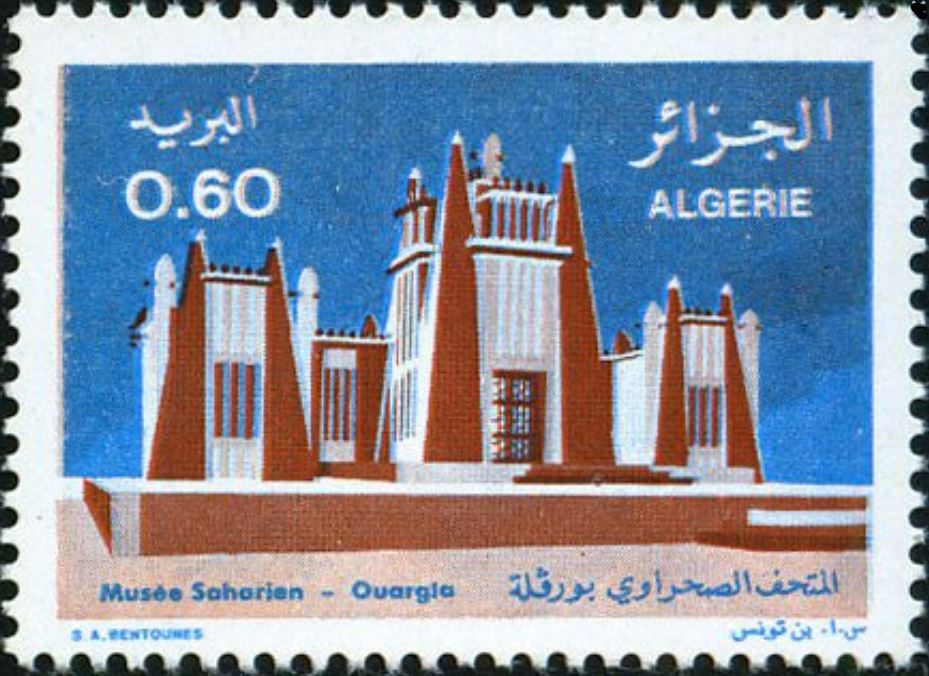
Saharan Museum of Ouargla
Built in 1936, the Saharan Museum of Ouargla is characterized by neo-Sudanese architecture which, in the Sahara, risks appearing anachronistic. However, it is undeniable that the whole presents at dusk a certain originality marked by an austere and imposing appearance.
This museum is not one in the literal sense of the term. In fact, we should find objects there which owe their value to their age or their rarity. Here, for reasons coming from the way of life of the inhabitants of the Sahara, this aspect is lacking.
Indeed, climatic conditions, which have forced part of the population to adopt a nomadic lifestyle, have reduced utensils and furniture to the bare essentials. In addition, the standard of living, often very low, led sedentary populations to make the most of what they had.
Finally, independently of the utilitarian value of an object, a spiritual and family value is frequently attached to it which has been conferred on it by its previous owners.
This building is therefore less of a museum than a place where local Saharan craft products have been brought together, chosen mainly according to their traditional aesthetic and their authenticity.
The building consists of a hall and three rooms. The hall is dedicated to photographic reproductions showing different tourist sites as well as traditional artisans at work. They were chosen based on their aesthetic and ethnographic character. In room no. 1, objects of various origins are gathered (old Arab rifles, black African puzzles, armchairs carved from palm trunks, tapestry, etc.). Room no. 2 mainly focuses on the ethnography of the Ouargla region. Room no. 3 is devoted to prehistory. The different display cases show the product of various prehistoric industries from the Paleolithic to the Neolithic.
After reviewing the traditional Sahara, visitors access a fourth room called the “Oil Room”. This, entirely equipped by Sonatrach, shows the new face of the South as it is currently being built.
This museum is not one in the literal sense of the term. In fact, we should find objects there which owe their value to their age or their rarity. Here, for reasons coming from the way of life of the inhabitants of the Sahara, this aspect is lacking.
Indeed, climatic conditions, which have forced part of the population to adopt a nomadic lifestyle, have reduced utensils and furniture to the bare essentials. In addition, the standard of living, often very low, led sedentary populations to make the most of what they had.
Finally, independently of the utilitarian value of an object, a spiritual and family value is frequently attached to it which has been conferred on it by its previous owners.
This building is therefore less of a museum than a place where local Saharan craft products have been brought together, chosen mainly according to their traditional aesthetic and their authenticity.
The building consists of a hall and three rooms. The hall is dedicated to photographic reproductions showing different tourist sites as well as traditional artisans at work. They were chosen based on their aesthetic and ethnographic character. In room no. 1, objects of various origins are gathered (old Arab rifles, black African puzzles, armchairs carved from palm trunks, tapestry, etc.). Room no. 2 mainly focuses on the ethnography of the Ouargla region. Room no. 3 is devoted to prehistory. The different display cases show the product of various prehistoric industries from the Paleolithic to the Neolithic.
After reviewing the traditional Sahara, visitors access a fourth room called the “Oil Room”. This, entirely equipped by Sonatrach, shows the new face of the South as it is currently being built.