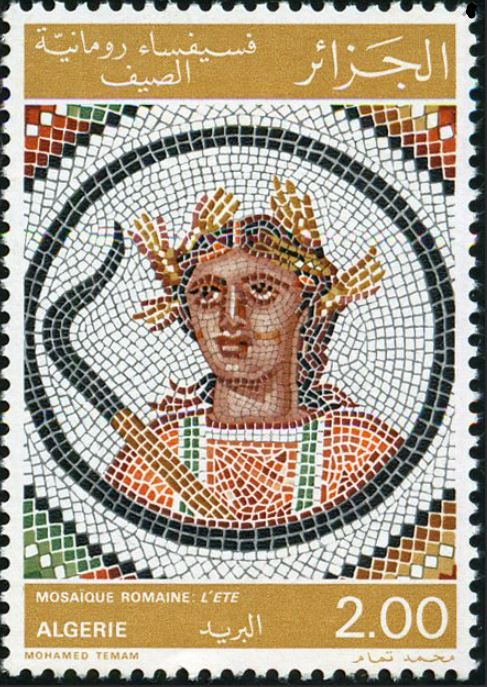
Roman Mosaics Summer
Roman mosaics In Antiquity, the floors of the wealthiest homes were often covered in mosaic where geometric patterns alternated with figurative representations.
The art of mosaic had reached such a high degree of perfection in ancient Africa that African mosaicists were often sought after far outside Africa to decorate palaces and homes.
On a technical level, the art of mosaic requires great skill, particularly in the search for colors and the size of the cubes or tesserae, the dimensions of which can go up to 2 or 3 millimeters on a side.
However, when we look at a mosaic, in a museum for example, we manage to forget that it is not the painting that it appears to be.
The theme of the four seasons which appears in the mosaic preserved at the National Museum of Antiquities in Algiers was one of the permanent themes of decorative iconography in Antiquity. It is found in the bas-reliefs of arches, notably in the arch of Septimius Severus, the African emperor, in Rome.
We also see it appearing on sarcophagi and ancient frescoes. The Seasons mosaic preserved in Algiers comes from an ancient residence in Aïn Babouche, in the daïra of Aïn Beïda, and undoubtedly dates from the 2nd century AD.
It is made up of 6 medallions framed by braids in gradient lines. Two medallions are illustrated with baskets of fruit (figs and grapes); in the four remaining medallions, busts or allegorical portraits are represented, symbolizing in a beautiful modeling technique the four seasons with their attributes.
- Spring: crown of flowers and basket of fruit.
- Summer: crown of wheat and scythe ears.
- Autumn: crown of bunches of grapes and scepter.
- Winter: crown of thorns, olive branch and billhook.
These portraits could also be the representation of deities of pagan worship, based on agrarian rites whose importance in Antiquity no longer needs to be emphasized.
The art of mosaic had reached such a high degree of perfection in ancient Africa that African mosaicists were often sought after far outside Africa to decorate palaces and homes.
On a technical level, the art of mosaic requires great skill, particularly in the search for colors and the size of the cubes or tesserae, the dimensions of which can go up to 2 or 3 millimeters on a side.
However, when we look at a mosaic, in a museum for example, we manage to forget that it is not the painting that it appears to be.
The theme of the four seasons which appears in the mosaic preserved at the National Museum of Antiquities in Algiers was one of the permanent themes of decorative iconography in Antiquity. It is found in the bas-reliefs of arches, notably in the arch of Septimius Severus, the African emperor, in Rome.
We also see it appearing on sarcophagi and ancient frescoes. The Seasons mosaic preserved in Algiers comes from an ancient residence in Aïn Babouche, in the daïra of Aïn Beïda, and undoubtedly dates from the 2nd century AD.
It is made up of 6 medallions framed by braids in gradient lines. Two medallions are illustrated with baskets of fruit (figs and grapes); in the four remaining medallions, busts or allegorical portraits are represented, symbolizing in a beautiful modeling technique the four seasons with their attributes.
- Spring: crown of flowers and basket of fruit.
- Summer: crown of wheat and scythe ears.
- Autumn: crown of bunches of grapes and scepter.
- Winter: crown of thorns, olive branch and billhook.
These portraits could also be the representation of deities of pagan worship, based on agrarian rites whose importance in Antiquity no longer needs to be emphasized.