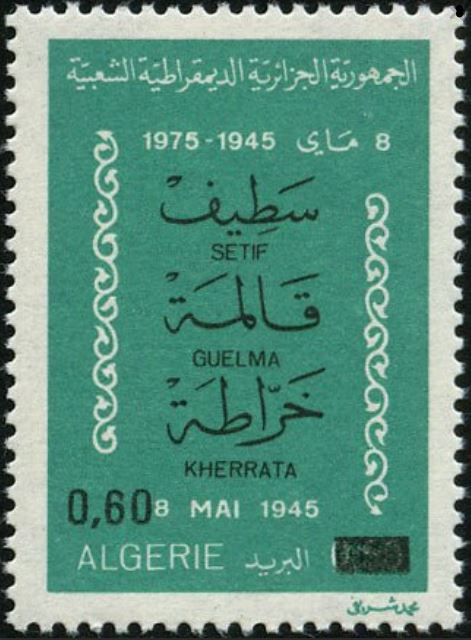
Massacres of Sétif, Guelma and Kherrata
What colonial France called the “events” of Sétif, Guelma and Kherrata were, in fact, horrible massacres perpetrated by settlers aided by members of the colonial authority’s security forces against the local populations.
At the end of a Second World War, to the success of which the Algerians contributed greatly through their mobilization alongside the allied forces, demonstrations of joy and euphoria multiplied across Europe, America and Africa.
In Sétif, Algerians take to the streets to show their joy, but also to demand independence and freedom, in accordance with the promises made by the colonizer.
Alongside the flags of the Allies, the Algerian flag publicly appears in the procession. Slogans demand independence as well as the release of Messali Hadj, leader of the Algerian People's Party (PPA), placed under house arrest.
Ordered to lower his flag, Bouzid Saal refused to comply, which resulted in him being executed on the spot. The demonstration, until then peaceful, then turned into a riot.
In Guelma, Kherrata and in several towns and villages in the Babors range, demonstrations were repressed. The repression will be savage and indiscriminate: collective massacres, citizens burned alive, manhunts, burials in mass graves, bodies charred in lime kilns...
The death toll is 45,000, if not more. The colonial power half-heartedly recognizes the facts, invoking “reasons of state”. Diplomatic and consular representations in Algeria unequivocally confirm, in reports sent to their governments, the terrible repression which fell on the Algerian population, emphasizing the latter's aspiration for independence.
These massacres definitely made the Algerians aware that colonial France would never give them back their independence and freedom and that armed struggle was the only way to regain them.
At the end of a Second World War, to the success of which the Algerians contributed greatly through their mobilization alongside the allied forces, demonstrations of joy and euphoria multiplied across Europe, America and Africa.
In Sétif, Algerians take to the streets to show their joy, but also to demand independence and freedom, in accordance with the promises made by the colonizer.
Alongside the flags of the Allies, the Algerian flag publicly appears in the procession. Slogans demand independence as well as the release of Messali Hadj, leader of the Algerian People's Party (PPA), placed under house arrest.
Ordered to lower his flag, Bouzid Saal refused to comply, which resulted in him being executed on the spot. The demonstration, until then peaceful, then turned into a riot.
In Guelma, Kherrata and in several towns and villages in the Babors range, demonstrations were repressed. The repression will be savage and indiscriminate: collective massacres, citizens burned alive, manhunts, burials in mass graves, bodies charred in lime kilns...
The death toll is 45,000, if not more. The colonial power half-heartedly recognizes the facts, invoking “reasons of state”. Diplomatic and consular representations in Algeria unequivocally confirm, in reports sent to their governments, the terrible repression which fell on the Algerian population, emphasizing the latter's aspiration for independence.
These massacres definitely made the Algerians aware that colonial France would never give them back their independence and freedom and that armed struggle was the only way to regain them.