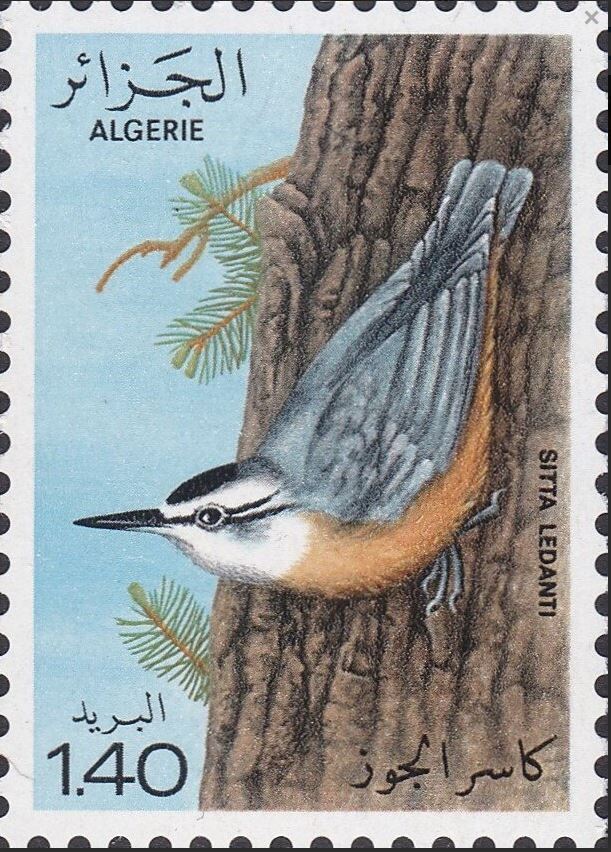
La Sitelle
This passerine, which does not exceed 13.5 cm, overshadowed all the birds for years, well after its discovery in 1975 by J.-P. Ledant.
This late discovery is surprising given that it is the only bird endemic to Algeria. With a population estimated at less than 1,000 individuals, the Kabylie nuthatch remains threatened.
This species lives in four mountain areas in the northeast of the country, in Kabylia, covering less than 250 km2. It favors tall coniferous forests above 2,000 m, oak forests located between 350 and 1,120 m and degraded forests between 900 and 1,400 m above sea level.
This rotund creature with a short tail is characterized by its small black cap and its very clear white eyebrow in the male. Gray above, white throat, orange breast and belly, the nuthatch emits “tseet-tseet” cries and a fluty “quair-di, quair-di” song.
The female does not have black on her crown and is of an overall paler color. The young people, for their part, are gloomy. In summer, it feeds on insects hunted at the ends of branches and the bark of trunks. In winter, it mixes with other species such as tits and finches to consume acorns, cedar and fir seeds.
She stores a part as a reserve in the crevices of the trunks by propping it up. The Kabyle nuthatch climbs in all directions on trees and remains the only bird capable of moving upside down. She digs her own nest when she is not using those of woodpeckers.
Wary, it always nests high up between 5 and 15 m, in a trunk or a large branch. The nest is lined with shards of wood, dead leaves, fine wild boar hair and feathers. Its orifice is sometimes surrounded by a layer of mud.
The nesting season extends between May and June. The clutch, at the end of May - beginning of June, is 3 white eggs spotted with purple, incubated by the female. After hatching, both parents are responsible for feeding the chicks for around twenty days, until they fly.
This late discovery is surprising given that it is the only bird endemic to Algeria. With a population estimated at less than 1,000 individuals, the Kabylie nuthatch remains threatened.
This species lives in four mountain areas in the northeast of the country, in Kabylia, covering less than 250 km2. It favors tall coniferous forests above 2,000 m, oak forests located between 350 and 1,120 m and degraded forests between 900 and 1,400 m above sea level.
This rotund creature with a short tail is characterized by its small black cap and its very clear white eyebrow in the male. Gray above, white throat, orange breast and belly, the nuthatch emits “tseet-tseet” cries and a fluty “quair-di, quair-di” song.
The female does not have black on her crown and is of an overall paler color. The young people, for their part, are gloomy. In summer, it feeds on insects hunted at the ends of branches and the bark of trunks. In winter, it mixes with other species such as tits and finches to consume acorns, cedar and fir seeds.
She stores a part as a reserve in the crevices of the trunks by propping it up. The Kabyle nuthatch climbs in all directions on trees and remains the only bird capable of moving upside down. She digs her own nest when she is not using those of woodpeckers.
Wary, it always nests high up between 5 and 15 m, in a trunk or a large branch. The nest is lined with shards of wood, dead leaves, fine wild boar hair and feathers. Its orifice is sometimes surrounded by a layer of mud.
The nesting season extends between May and June. The clutch, at the end of May - beginning of June, is 3 white eggs spotted with purple, incubated by the female. After hatching, both parents are responsible for feeding the chicks for around twenty days, until they fly.