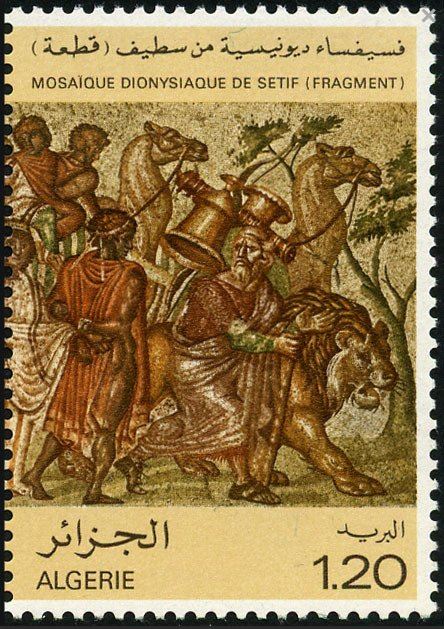
Dionysian mosaic from Sétif
Roman art found one of its best expressions in mosaic. The Maghreb, more particularly Algeria and Tunisia, have a very rich collection.
Recently, one of the most important mosaics and not the least beautiful, discovered in Sétif, came to enrich this heritage. It represents the triumphant return of Dionysus from his legendary journey. Legend tells us that the divinity undertook this journey to India and there are numerous graphic representations of this journey.
The Sétif mosaic tells us, for the first time, that this journey was undertaken in Africa. Indeed, we note that the captives brought back in his procession, formerly Indians, are Africans in this painting: a couple and their two children, hands tied behind their backs and perched on a dromedary.
In the middle of the procession, we first notice the enormous head of an African elephant with fan-shaped ears, then the presence of a giraffe, an exclusively African animal. In other words, if we can doubt the “Africanness” of the dromedary, we refrain from doing so in the case of the giraffe whose natural space was circumscribed on African soil at that time.
So we are sure that this is a transposition of the theme of the triumph of Dionysus from India to Africa. The study of the decoration, the technique and the richness of the composition, on the one hand, and the study of the district where it was discovered, on the other hand, allow us to date the mosaic towards the end of the 2nd century or the beginning of the 3rd century of the Christian era.
However, the iconography and texts, especially Tertullian's Apologetics, testify to a resurgence of paganism in this period when the era of anti-Christian persecutions began in Africa. This is what undoubtedly explains this flourishing of pagan art of which the Dionysian mosaic of Sétif is one of the reflections. It is also the reflection of a particularly refined art, that of itinerant artists coming from Alexandria recognizable by the realism of the drawing, the precise use of fine prisms (sometimes 2 mm) and the choice of colors.
The scale, the state of conservation, the historical and artistic interest make the Dionysian mosaic of Sétif one of the centerpieces of the national and universal cultural heritage.
Recently, one of the most important mosaics and not the least beautiful, discovered in Sétif, came to enrich this heritage. It represents the triumphant return of Dionysus from his legendary journey. Legend tells us that the divinity undertook this journey to India and there are numerous graphic representations of this journey.
The Sétif mosaic tells us, for the first time, that this journey was undertaken in Africa. Indeed, we note that the captives brought back in his procession, formerly Indians, are Africans in this painting: a couple and their two children, hands tied behind their backs and perched on a dromedary.
In the middle of the procession, we first notice the enormous head of an African elephant with fan-shaped ears, then the presence of a giraffe, an exclusively African animal. In other words, if we can doubt the “Africanness” of the dromedary, we refrain from doing so in the case of the giraffe whose natural space was circumscribed on African soil at that time.
So we are sure that this is a transposition of the theme of the triumph of Dionysus from India to Africa. The study of the decoration, the technique and the richness of the composition, on the one hand, and the study of the district where it was discovered, on the other hand, allow us to date the mosaic towards the end of the 2nd century or the beginning of the 3rd century of the Christian era.
However, the iconography and texts, especially Tertullian's Apologetics, testify to a resurgence of paganism in this period when the era of anti-Christian persecutions began in Africa. This is what undoubtedly explains this flourishing of pagan art of which the Dionysian mosaic of Sétif is one of the reflections. It is also the reflection of a particularly refined art, that of itinerant artists coming from Alexandria recognizable by the realism of the drawing, the precise use of fine prisms (sometimes 2 mm) and the choice of colors.
The scale, the state of conservation, the historical and artistic interest make the Dionysian mosaic of Sétif one of the centerpieces of the national and universal cultural heritage.