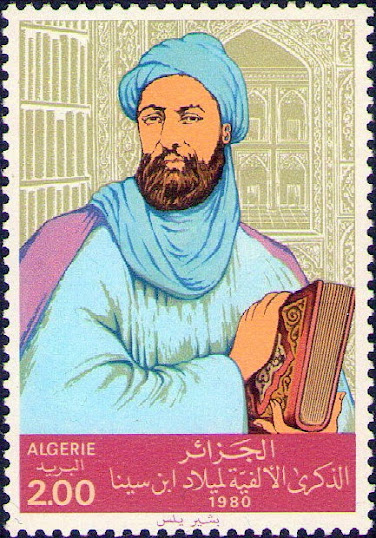
Millennium of the Birth of Avicenna (980-1037)
Abou Ali El Hussaïn Ibn Abdullah Ibn Sina, known in the West as Avicenna, was born in 980 AD in Afshana, near Bukhara, in then Persia (present-day Soviet Tajikistan).
Died in 1037 at the age of 57 and buried in Hamadan, in present-day Iran, his tomb is still a place of pilgrimage. He is one of the most remarkable scientists for the extent of his knowledge.
At the age of 10, he recited the entire Koran by heart. At 16, he began researching medicine and at 18, he was appointed physician to the king's court. This position gave him access to the royal library and within three years he had written a 21-volume encyclopedia.
For a time he was grand vizier, but fell into disgrace along with his prince and was thrown into prison. Whenever he could, he collected and counted all the knowledge of his time and wrote works on natural sciences, philosophy, meteorology, physics and zoology.
Ibn Sina's most important work is Al Qanun fi tib or The Canon of Medicine which would leave its mark on the theory of medical practice for centuries. This work is a compilation of all the knowledge of Arab medicine of the time, of the discoveries that Greek doctors had made earlier, and of the results that the author himself had drawn from his own investigations into pathological conditions, their prevention and treatment.
The author describes with great precision certain disorders such as pleurisy and intestinal disorders and also gives a description of several serious epidemic diseases, including smallpox and measles. And, for the first time, pulmonary tuberculosis is considered a contagious disease.
Ibn Sina laid the foundations of the art of healing. He contributed more than any other to the development of universal medical science. “I will untie the knot of death and men will live a long time,” he wrote in The Canon of Medicine.
His medical treatises have been republished twelve times in Latin. He also contributed to the development of natural sciences and philosophy and is the author of numerous verses. In addition to his contribution to the progress of medicine, Ibn Sina was also a remarkable musician and musicologist. Author of five works on music, he considered this art as a product of the human spirit and, in his famous Canon of Medicine, he evoked its therapeutic virtues, well ahead of his time in terms of the possibilities of treating certain illnesses through music.
His essay on musical science includes a hundred pages devoted to the theory of music, starting with the characteristic of musical sound, the formation of intervals and tones up to the links of music and verse and the educational role of musical art. Knowing the human organism in depth, Ibn Sina called people to learn about beauty to “achieve a more complete harmony”.
During its last General Conference, UNESCO decided to celebrate the Millennium of Ibn Sina in 1980. This decision pays tribute to the illustrious scholar for his large contribution to the progress of all humanity and the influence of his legacy on the evolution of medicine in particular and other sciences in general.
Died in 1037 at the age of 57 and buried in Hamadan, in present-day Iran, his tomb is still a place of pilgrimage. He is one of the most remarkable scientists for the extent of his knowledge.
At the age of 10, he recited the entire Koran by heart. At 16, he began researching medicine and at 18, he was appointed physician to the king's court. This position gave him access to the royal library and within three years he had written a 21-volume encyclopedia.
For a time he was grand vizier, but fell into disgrace along with his prince and was thrown into prison. Whenever he could, he collected and counted all the knowledge of his time and wrote works on natural sciences, philosophy, meteorology, physics and zoology.
Ibn Sina's most important work is Al Qanun fi tib or The Canon of Medicine which would leave its mark on the theory of medical practice for centuries. This work is a compilation of all the knowledge of Arab medicine of the time, of the discoveries that Greek doctors had made earlier, and of the results that the author himself had drawn from his own investigations into pathological conditions, their prevention and treatment.
The author describes with great precision certain disorders such as pleurisy and intestinal disorders and also gives a description of several serious epidemic diseases, including smallpox and measles. And, for the first time, pulmonary tuberculosis is considered a contagious disease.
Ibn Sina laid the foundations of the art of healing. He contributed more than any other to the development of universal medical science. “I will untie the knot of death and men will live a long time,” he wrote in The Canon of Medicine.
His medical treatises have been republished twelve times in Latin. He also contributed to the development of natural sciences and philosophy and is the author of numerous verses. In addition to his contribution to the progress of medicine, Ibn Sina was also a remarkable musician and musicologist. Author of five works on music, he considered this art as a product of the human spirit and, in his famous Canon of Medicine, he evoked its therapeutic virtues, well ahead of his time in terms of the possibilities of treating certain illnesses through music.
His essay on musical science includes a hundred pages devoted to the theory of music, starting with the characteristic of musical sound, the formation of intervals and tones up to the links of music and verse and the educational role of musical art. Knowing the human organism in depth, Ibn Sina called people to learn about beauty to “achieve a more complete harmony”.
During its last General Conference, UNESCO decided to celebrate the Millennium of Ibn Sina in 1980. This decision pays tribute to the illustrious scholar for his large contribution to the progress of all humanity and the influence of his legacy on the evolution of medicine in particular and other sciences in general.