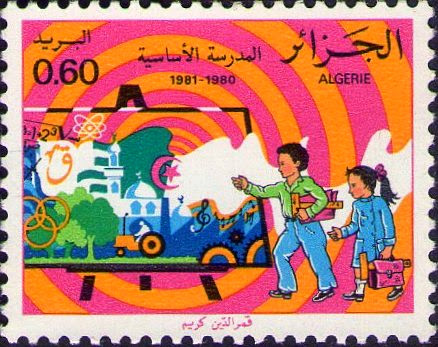
Basic School 1980-1981
The order on the organization of education and training appeared on April 16, 1976 with all the implementing texts relating to it and which highlight the essential principles governing education.
This ordinance, with the resulting implementing texts, is the first text developed after independence which aims to define the philosophy of education and training in Algeria and aims to replace the legislation applied in this area until that date.
After four years of effort, preparation and experimentation, the Ministry of Education and Basic Education decided to set up, from the start of the 1980-1981 school year, the new educational system which gives teaching a social aspect in addition to its scientific and technological content.
For the autonomous groups, primary school and middle school, the basic school replaces a single and coherent structure in which the school curriculum takes place without obstacles or difficult passages to overcome.
The structure offered by the basic school takes into account the biological reality which characterizes the development of the child as well as the needs of the educational action itself. It includes three integrated sets representing:
- the first level which corresponds to the first level of basic school and lasts three years from 6 to 9 years old;
- the second level or second degree which covers the period from 9 to 12 years;
- the third level or third degree which constitutes the last element of the structure and lasts three years from 13 to 15/16 years old.
The mission of the basic school is to provide a common basic education to all children aged 6 to 16.
Education in this age group is a right and an obligation. It is also free at all levels, regardless of the type of establishment attended. It is also emphasized that the education system is the exclusive responsibility of the State and that it is part of the overall development plan.
In addition, the educational system has the following missions within the framework of Arab-Islamic values:
- the development of the personality of children and citizens and their preparation for active life;
- the acquisition of general, literary, scientific and technological knowledge;
- the response to popular aspirations for justice and progress;
- the awakening of consciences to love of the homeland.
This ordinance, with the resulting implementing texts, is the first text developed after independence which aims to define the philosophy of education and training in Algeria and aims to replace the legislation applied in this area until that date.
After four years of effort, preparation and experimentation, the Ministry of Education and Basic Education decided to set up, from the start of the 1980-1981 school year, the new educational system which gives teaching a social aspect in addition to its scientific and technological content.
For the autonomous groups, primary school and middle school, the basic school replaces a single and coherent structure in which the school curriculum takes place without obstacles or difficult passages to overcome.
The structure offered by the basic school takes into account the biological reality which characterizes the development of the child as well as the needs of the educational action itself. It includes three integrated sets representing:
- the first level which corresponds to the first level of basic school and lasts three years from 6 to 9 years old;
- the second level or second degree which covers the period from 9 to 12 years;
- the third level or third degree which constitutes the last element of the structure and lasts three years from 13 to 15/16 years old.
The mission of the basic school is to provide a common basic education to all children aged 6 to 16.
Education in this age group is a right and an obligation. It is also free at all levels, regardless of the type of establishment attended. It is also emphasized that the education system is the exclusive responsibility of the State and that it is part of the overall development plan.
In addition, the educational system has the following missions within the framework of Arab-Islamic values:
- the development of the personality of children and citizens and their preparation for active life;
- the acquisition of general, literary, scientific and technological knowledge;
- the response to popular aspirations for justice and progress;
- the awakening of consciences to love of the homeland.