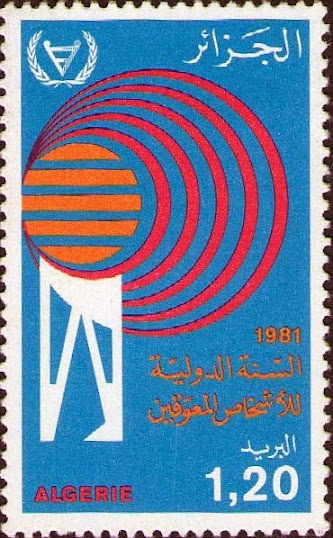
International Year of People with Disabilities
The year 1981 was declared by the United Nations General Assembly as the International Year of Persons with Disabilities. According to the United Nations, 400 million people worldwide have a physical or mental disability, or 10% of the world's population.
This colossal figure captures our sensitivity, but also gives rise to reflections of a social, political and economic order, because this tenth of the population is until now, as a whole, an excessively heavy social burden, especially for the countries of the Third World, victims more than others of the consequences of a war or a natural cataclysm and which, not having benefited in the past from the most advanced sanitary equipment nor from a sufficient quantity of it, have seen the disabled of all kinds. so they can multiply in their territories.
However, these four hundred million disabled people are not useless mouths. If one is missing an arm or a leg, if another is blind or deaf, they lack neither the intelligence nor the skill to put all their other faculties at the service of the community.
The kindness and physical qualities of those whose intelligence quotient is not high can allow them to secure numerous jobs that are as advantageous as for a normal worker.
Algeria, which has, according to surveys prior to the recent and terrible earthquake in El Asnam, 900,000 disabled people (5% of its total population), the equivalent of a city like Annaba, did not wait until 1981 to implement this policy of “full participation”.
What is necessary is for the entire population, and each citizen for their part, to learn to see in the disabled person not a different being, but on the contrary a man living like the others who has his full and useful place in the life of the nation.
The year 1981 will be used to complete this work and ensure the disabled person's "full participation" through effective integration into social life.
This colossal figure captures our sensitivity, but also gives rise to reflections of a social, political and economic order, because this tenth of the population is until now, as a whole, an excessively heavy social burden, especially for the countries of the Third World, victims more than others of the consequences of a war or a natural cataclysm and which, not having benefited in the past from the most advanced sanitary equipment nor from a sufficient quantity of it, have seen the disabled of all kinds. so they can multiply in their territories.
However, these four hundred million disabled people are not useless mouths. If one is missing an arm or a leg, if another is blind or deaf, they lack neither the intelligence nor the skill to put all their other faculties at the service of the community.
The kindness and physical qualities of those whose intelligence quotient is not high can allow them to secure numerous jobs that are as advantageous as for a normal worker.
Algeria, which has, according to surveys prior to the recent and terrible earthquake in El Asnam, 900,000 disabled people (5% of its total population), the equivalent of a city like Annaba, did not wait until 1981 to implement this policy of “full participation”.
What is necessary is for the entire population, and each citizen for their part, to learn to see in the disabled person not a different being, but on the contrary a man living like the others who has his full and useful place in the life of the nation.
The year 1981 will be used to complete this work and ensure the disabled person's "full participation" through effective integration into social life.