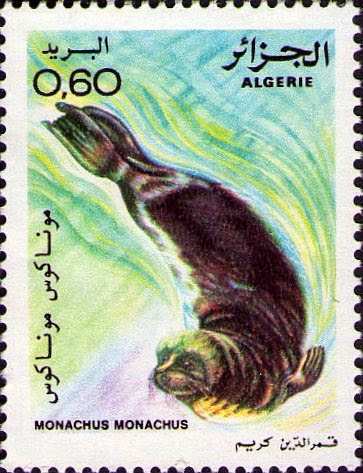
Monachus monachus Seal
The monk seal (pinniped mammal) Monachus monachus
Commonly called seal calf, the monk seal or Monachus monachus is the only species of seal found on the Algerian coast and along the Mediterranean coasts.
The adult monk seal measures 2.30 m in length and weighs between 300 and 350 kg.
The back and sides are dark brown with a grayish green sheen.
The white or yellowish gray underside rises slightly on the sides.
The coat is short with the presence or absence of indistinct spots.
The claws are developed on the forelimbs, while they are reduced on the hind fins.
Living in groups, monk seals feed on crustaceans and fish.
They frequent sheltered places along shorelines and rocky coasts.
They rest in summer on rocks that are not easily accessible and in winter in caves whose entrance is underwater.
Monk seals generally congregate in narrow, limited areas.
Females reproduce once every two years and the young are born between July and September.
The biology, ecology and habits of these seals are little known.
Monk seals are found in the Mediterranean, in the Adriatic Sea, in the Black Sea and in the Atlantic Ocean, as far as the Canary Islands and Madeira.
In Algeria, they are reported to the west and east of Annaba, while no data exists for the Algerian region.
The world population is estimated at between 500 and 1,000 individuals only, the majority of which is confined to the eastern Mediterranean.
Once abundant along the coasts of the Mediterranean Sea, monk seals have since seen their numbers greatly reduced, because they were, for a long time, persecuted by fishermen for their meat, their fat and their skin, but also because they believed them to be harmful to their fisheries.
Tourist developments on certain coasts also disturb the peace and quiet of these animals.
All of these factors lead to a decrease in the reproduction rate of these seals.
These harmless and unsuspecting animals, threatened with extinction, constitute one of the riches of our coasts.
They deserve special attention and rigorous protection.
Commonly called seal calf, the monk seal or Monachus monachus is the only species of seal found on the Algerian coast and along the Mediterranean coasts.
The adult monk seal measures 2.30 m in length and weighs between 300 and 350 kg.
The back and sides are dark brown with a grayish green sheen.
The white or yellowish gray underside rises slightly on the sides.
The coat is short with the presence or absence of indistinct spots.
The claws are developed on the forelimbs, while they are reduced on the hind fins.
Living in groups, monk seals feed on crustaceans and fish.
They frequent sheltered places along shorelines and rocky coasts.
They rest in summer on rocks that are not easily accessible and in winter in caves whose entrance is underwater.
Monk seals generally congregate in narrow, limited areas.
Females reproduce once every two years and the young are born between July and September.
The biology, ecology and habits of these seals are little known.
Monk seals are found in the Mediterranean, in the Adriatic Sea, in the Black Sea and in the Atlantic Ocean, as far as the Canary Islands and Madeira.
In Algeria, they are reported to the west and east of Annaba, while no data exists for the Algerian region.
The world population is estimated at between 500 and 1,000 individuals only, the majority of which is confined to the eastern Mediterranean.
Once abundant along the coasts of the Mediterranean Sea, monk seals have since seen their numbers greatly reduced, because they were, for a long time, persecuted by fishermen for their meat, their fat and their skin, but also because they believed them to be harmful to their fisheries.
Tourist developments on certain coasts also disturb the peace and quiet of these animals.
All of these factors lead to a decrease in the reproduction rate of these seals.
These harmless and unsuspecting animals, threatened with extinction, constitute one of the riches of our coasts.
They deserve special attention and rigorous protection.