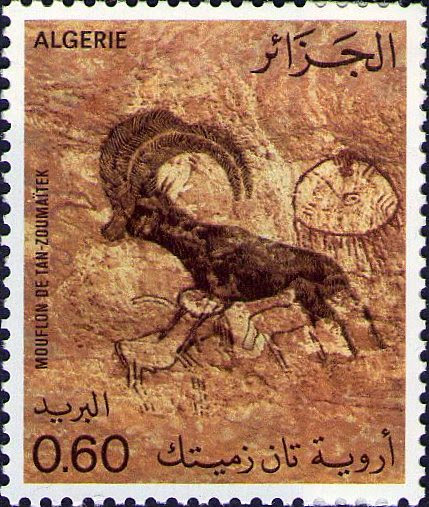
Tan-Zoumaïtek mouflon
Tassili N’Ajjer is home to thousands of rock paintings and engravings. The frescoes painted on the walls of the rock shelters, at the foot of the cliffs which border the dry wadis, and the figures engraved on slabs or blocks represent animals which have now disappeared from these latitudes and scenes of daily life which contrast with the current desert.
They attest to a very different climate, living conditions and population a few millennia ago. Although we cannot date the rock paintings exactly, we have nevertheless established a relative chronology by comparison and study of their superpositions. They are linked to the Neolithic era which must have begun in the Sahara approximately 10,000 years ago and are the work of successive peoples and groups who adapted to the increasingly difficult conditions of the desert.
The Tan Zoumaïtak mouflon is from the archaic period known as “round heads”; it is painted on a wall which has many superpositions.
The paintings of this “school” are enigmatic, often giant, accompanied by various signs and masked figures.
The mouflon is common there and the artist has always attached great importance to the animal's horns. The mouflon is still present in Tassili where its species is protected because it is threatened with extinction.
The other three subjects are linked to the Bovidian period which is located between approximately 4,000 and 2,000 years before the Christian era.
The paintings from this period are very numerous, of varied styles, but always of extraordinary realism. The fauna represented is dominated by large herds of oxen of which the magnificent polychrome herd of Jabbaren is a striking example.
It is exceptional for its very rich palette: all the colors are obtained from mineral products: ocher, schist, kaolin. The one-cornered cow of Jabbaren is also typical of this period. The oxen are always perfectly designed and the painters gave great importance to the horning of their animals, representing their various natural or man-made forms.
The bovids of Iherir are of a slightly different style. The themes are the same as in the rest of the Bovidian period: the composition and drawing are even more flexible and imaginative. The artist used here a crevice in the rock in which his oxen appear to be drinking.
They attest to a very different climate, living conditions and population a few millennia ago. Although we cannot date the rock paintings exactly, we have nevertheless established a relative chronology by comparison and study of their superpositions. They are linked to the Neolithic era which must have begun in the Sahara approximately 10,000 years ago and are the work of successive peoples and groups who adapted to the increasingly difficult conditions of the desert.
The Tan Zoumaïtak mouflon is from the archaic period known as “round heads”; it is painted on a wall which has many superpositions.
The paintings of this “school” are enigmatic, often giant, accompanied by various signs and masked figures.
The mouflon is common there and the artist has always attached great importance to the animal's horns. The mouflon is still present in Tassili where its species is protected because it is threatened with extinction.
The other three subjects are linked to the Bovidian period which is located between approximately 4,000 and 2,000 years before the Christian era.
The paintings from this period are very numerous, of varied styles, but always of extraordinary realism. The fauna represented is dominated by large herds of oxen of which the magnificent polychrome herd of Jabbaren is a striking example.
It is exceptional for its very rich palette: all the colors are obtained from mineral products: ocher, schist, kaolin. The one-cornered cow of Jabbaren is also typical of this period. The oxen are always perfectly designed and the painters gave great importance to the horning of their animals, representing their various natural or man-made forms.
The bovids of Iherir are of a slightly different style. The themes are the same as in the rest of the Bovidian period: the composition and drawing are even more flexible and imaginative. The artist used here a crevice in the rock in which his oxen appear to be drinking.