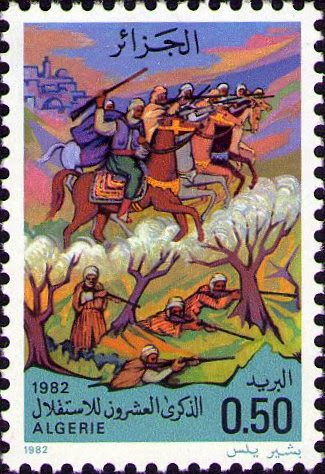
20th Anniversary of Independence (1962-1982)
The colonial invasion opened an era of resistance to the occupation which did not cease until Algeria regained its independence in 1962. This resistance took multiple forms. With Emir Abdelkader, the fight against the colonizer was accompanied by a lucid and coherent attempt to establish a modern state organization with well-articulated territorial structures, as well as a functional administrative organization.
In this form of struggle, loaded with potential for the emergence of a modern Algerian state capable of withstanding the shock with European civilization already entering the era of the industrial revolution, Algerian society lacked the necessary malleability allowing Emir Abdelkader to make the essential changes in a very short period of time.
After the failure of Emir Abdelkader, resistance continued, taking multiple forms. Whether they took the form of large-scale movements as was the case for the uprising of Ouled Sidi Cheikh in 1864 and that of El Mokrani in 1871 or local movements like those which took place almost everywhere in Algeria, these resistance movements have a common denominator. Even if they are the expression of a permanent rejection of colonization, they are all characterized by the absence of coordination and organization on a national scale.
After the armed resistance, the confrontation with colonialism was transferred to another level. From the First World War onwards, a movement of modern expression and organization gradually took shape. Different political groups seek to express and defend what each of them thought was the interest of the Algerian people.
It is the North African Star which posed the national problem in the most appropriate way. The demand for independence in February 1927 constitutes the beacon which illuminated the progress of this movement which, through the vagaries of repression and the successive changes that it experienced as a movement, made the idea of action for independence mature in popular consciousness until its ultimate point in 1954.
In this form of struggle, loaded with potential for the emergence of a modern Algerian state capable of withstanding the shock with European civilization already entering the era of the industrial revolution, Algerian society lacked the necessary malleability allowing Emir Abdelkader to make the essential changes in a very short period of time.
After the failure of Emir Abdelkader, resistance continued, taking multiple forms. Whether they took the form of large-scale movements as was the case for the uprising of Ouled Sidi Cheikh in 1864 and that of El Mokrani in 1871 or local movements like those which took place almost everywhere in Algeria, these resistance movements have a common denominator. Even if they are the expression of a permanent rejection of colonization, they are all characterized by the absence of coordination and organization on a national scale.
After the armed resistance, the confrontation with colonialism was transferred to another level. From the First World War onwards, a movement of modern expression and organization gradually took shape. Different political groups seek to express and defend what each of them thought was the interest of the Algerian people.
It is the North African Star which posed the national problem in the most appropriate way. The demand for independence in February 1927 constitutes the beacon which illuminated the progress of this movement which, through the vagaries of repression and the successive changes that it experienced as a movement, made the idea of action for independence mature in popular consciousness until its ultimate point in 1954.