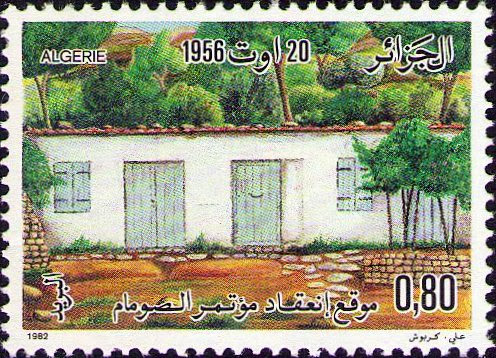
26th Anniversary of the Soummam Congress
The War of National Liberation began on November 1, 1954 with paltry human and material resources and a summary military organization. Nearly twenty months later, the Revolution was effectively taken up in fire and blood by the Algerian people mobilized behind the National Liberation Army (ALN) and the National Liberation Front (FLN).
The scale of the development of the struggle has imposed the need for those responsible for this struggle to meet in order to take stock of the situation and consider future prospects. This is the purpose of the Soummam Congress which took place on August 20, 1956 in a country house located in the dechra of Ifri, commune of Ouzellaguen, daïra of Akbou, wilaya of Béjaïa. After taking stock of twenty months of struggle and recording the progress made on the political and military levels, the congress discussed and adopted a platform establishing the strategy of the Revolution as well as the political and military organization to serve as a framework for the continuation of the war.
As part of the strategy, the congress first recalled the goals to be achieved, namely those already stated by the proclamation of November 1, 1954: national independence and Algerian sovereignty over the entire territory. The means to achieve this result is the armed struggle led by the Algerian people mobilized behind the FLN and the ALN.
All means will be implemented on the basis of principles set out by the platform: primacy of politics over military, primacy of the interior over the exterior, as well as the need for collegiality of management at different levels. As part of the political-military organization, the Soummam Congress carried out a territorial structuring of Algeria into six wilayas, themselves subdivided into mintaqate (zones) within which the nahiate (regions) which will include the qisms (sectors) will be created.
The structuring of the army resulted in the organization of the different combat units: initially the faoudj (group) then the firqa (section) then the katiba (company) and finally the failaq (battalion), by the fixing of ranks ranging from corporal to colonel and by the determination of the composition of the command. This composition is uniform from qism to the wilaya: at each level, there is the politico-military leader representing the central authority, surrounded by deputies numbering three, who are officers or non-commissioned officers, depending on the level of the territorial structure, dealing with the political branch, the military branch or the intelligence and liaison branch.
The scale of the development of the struggle has imposed the need for those responsible for this struggle to meet in order to take stock of the situation and consider future prospects. This is the purpose of the Soummam Congress which took place on August 20, 1956 in a country house located in the dechra of Ifri, commune of Ouzellaguen, daïra of Akbou, wilaya of Béjaïa. After taking stock of twenty months of struggle and recording the progress made on the political and military levels, the congress discussed and adopted a platform establishing the strategy of the Revolution as well as the political and military organization to serve as a framework for the continuation of the war.
As part of the strategy, the congress first recalled the goals to be achieved, namely those already stated by the proclamation of November 1, 1954: national independence and Algerian sovereignty over the entire territory. The means to achieve this result is the armed struggle led by the Algerian people mobilized behind the FLN and the ALN.
All means will be implemented on the basis of principles set out by the platform: primacy of politics over military, primacy of the interior over the exterior, as well as the need for collegiality of management at different levels. As part of the political-military organization, the Soummam Congress carried out a territorial structuring of Algeria into six wilayas, themselves subdivided into mintaqate (zones) within which the nahiate (regions) which will include the qisms (sectors) will be created.
The structuring of the army resulted in the organization of the different combat units: initially the faoudj (group) then the firqa (section) then the katiba (company) and finally the failaq (battalion), by the fixing of ranks ranging from corporal to colonel and by the determination of the composition of the command. This composition is uniform from qism to the wilaya: at each level, there is the politico-military leader representing the central authority, surrounded by deputies numbering three, who are officers or non-commissioned officers, depending on the level of the territorial structure, dealing with the political branch, the military branch or the intelligence and liaison branch.