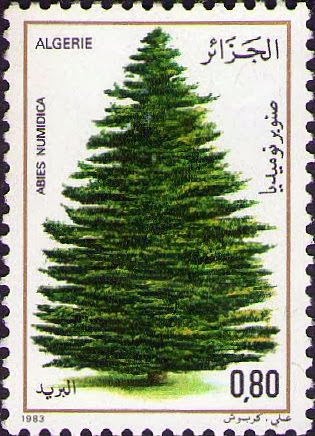
Abies numidica (Numidian Fir)
The Numidian fir Abies numidica
From the Pinaceae family, the Numidian fir, locally called taoument, is an endemic species and a relic of the flora that existed in North Africa during the last ice age.
When the climate warmed, it only persisted in mountainous areas. Currently, it is limited to eastern Kabylia, in the Babor and Tababor massifs, located between 1,300 and 2,000 m above sea level.
This species never constitutes pure stands. It is found mixed with Atlas cedar at altitude and Zen oak lower down.
This conifer is resistant to summer drought and has little fear of spring frosts. Very branchy, the Numidian fir, which has a pyramidal crown, reaches 15 to 20 m high.
Its needles are isolated, never in bundles like the pine, they are quite short, very stiff, often notched at the top with two whitish longitudinal bands on the underside.
The cones are oblong and stand up on the branches like the cedar; they disarticulate at maturity. The seeds are winged and their dispersal is by the wind.
Its wood, quite similar to that of other fir trees, cannot be exploited, due to the extreme reduction in the distribution area of the species which must benefit from severe and continuous protection.
The first reforestation attempts in the Tell Atlas massifs gave very satisfactory results.
From the Pinaceae family, the Numidian fir, locally called taoument, is an endemic species and a relic of the flora that existed in North Africa during the last ice age.
When the climate warmed, it only persisted in mountainous areas. Currently, it is limited to eastern Kabylia, in the Babor and Tababor massifs, located between 1,300 and 2,000 m above sea level.
This species never constitutes pure stands. It is found mixed with Atlas cedar at altitude and Zen oak lower down.
This conifer is resistant to summer drought and has little fear of spring frosts. Very branchy, the Numidian fir, which has a pyramidal crown, reaches 15 to 20 m high.
Its needles are isolated, never in bundles like the pine, they are quite short, very stiff, often notched at the top with two whitish longitudinal bands on the underside.
The cones are oblong and stand up on the branches like the cedar; they disarticulate at maturity. The seeds are winged and their dispersal is by the wind.
Its wood, quite similar to that of other fir trees, cannot be exploited, due to the extreme reduction in the distribution area of the species which must benefit from severe and continuous protection.
The first reforestation attempts in the Tell Atlas massifs gave very satisfactory results.