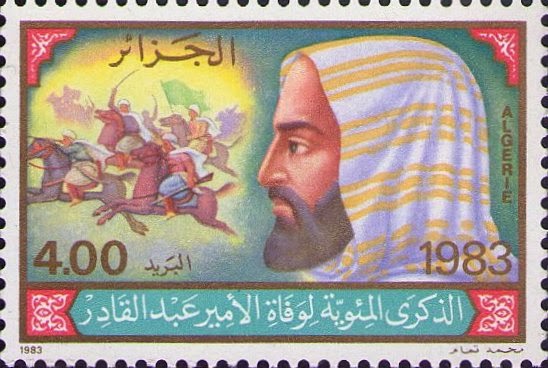
Centenary of the death of Emir Abd-El-Kader
Abdelkader, fourth son of Abdelkader Mahieddine, was born in 1808 in Mascara, on the banks of Wadi Hammam, near Mascara. At a very young age, he assiduously attended the Koranic school and the zaouïas to acquire the most diverse knowledge and sciences while having an undeniable interest in Arabic poetry and prose.
Passionate about theology and a fervent reader of Arab literary works, Abdelkader made contact with intellectuals from the East during his pilgrimage to Mecca in 1826. His journey, which lasted two years, greatly moved the young Abdelkader. It was at that moment that he aspired to become a great scholar, a destiny that was shattered on the rocks of history as events rushed forward in his country.
The landing of French troops in 1830 created a new situation which would fundamentally transform the life of young Abdelkader. He hastened to rally the resistance and it was under the walls of Oran that he was wounded in one of the first battles against the French invasion.
On November 22, 1832, a congress of the tribes of the Mascara region pledged allegiance to Abdelkader son of Mahieddine. Barely 24 years old, he became emir.
Abdelkader, the sensitive poet, displays rare skills, which border on genius, as a warrior and head of state. Despite the disproportion of forces, Abdelkader the fighter will confront the enemy, inflicting heavy losses on the invader. Meticulous knowledge of the terrain and military strategies of the time, brilliant intelligence and unrivaled enthusiasm will allow the barely united Algerian forces to win major battles.
On the diplomatic level, Abdelkader the head of state is beginning to secure support abroad. It marks important social and moral transformations which respond to the greatest urgency of the moment: defending the homeland.
He sees his State as centralized with a standing army and a salaried administration. Abdelkader doesn't just wage war. After his victories, he compromised with the enemy and took the time to organize production and trade while setting up a real war industry.
France's violation of the peace agreements in 1839 pushed the Emir and his army to enter into a war of resistance which lasted eight years, despite the enemy's obvious superiority in means. In 1847 the period of resistance ended with a conditional surrender.
This is how a long exile began for Emir Abdelkader which took him to France, Turkey and finally to Damascus, Syria, where he died on May 22, 1883.
After national independence, the remains of Emir Abdelkader were repatriated to Algiers on July 5, 1966 and buried in the El Alia cemetery alongside the martyrs of the Revolution. The commemoration of the centenary of the death of Emir Abdelkader is an opportunity for the Algerian people to relive a glorious epic. That of a national hero who never stopped fighting throughout his life to give the Arab nation its place among the great nations and the Algerian people their most legitimate right to national sovereignty.
Passionate about theology and a fervent reader of Arab literary works, Abdelkader made contact with intellectuals from the East during his pilgrimage to Mecca in 1826. His journey, which lasted two years, greatly moved the young Abdelkader. It was at that moment that he aspired to become a great scholar, a destiny that was shattered on the rocks of history as events rushed forward in his country.
The landing of French troops in 1830 created a new situation which would fundamentally transform the life of young Abdelkader. He hastened to rally the resistance and it was under the walls of Oran that he was wounded in one of the first battles against the French invasion.
On November 22, 1832, a congress of the tribes of the Mascara region pledged allegiance to Abdelkader son of Mahieddine. Barely 24 years old, he became emir.
Abdelkader, the sensitive poet, displays rare skills, which border on genius, as a warrior and head of state. Despite the disproportion of forces, Abdelkader the fighter will confront the enemy, inflicting heavy losses on the invader. Meticulous knowledge of the terrain and military strategies of the time, brilliant intelligence and unrivaled enthusiasm will allow the barely united Algerian forces to win major battles.
On the diplomatic level, Abdelkader the head of state is beginning to secure support abroad. It marks important social and moral transformations which respond to the greatest urgency of the moment: defending the homeland.
He sees his State as centralized with a standing army and a salaried administration. Abdelkader doesn't just wage war. After his victories, he compromised with the enemy and took the time to organize production and trade while setting up a real war industry.
France's violation of the peace agreements in 1839 pushed the Emir and his army to enter into a war of resistance which lasted eight years, despite the enemy's obvious superiority in means. In 1847 the period of resistance ended with a conditional surrender.
This is how a long exile began for Emir Abdelkader which took him to France, Turkey and finally to Damascus, Syria, where he died on May 22, 1883.
After national independence, the remains of Emir Abdelkader were repatriated to Algiers on July 5, 1966 and buried in the El Alia cemetery alongside the martyrs of the Revolution. The commemoration of the centenary of the death of Emir Abdelkader is an opportunity for the Algerian people to relive a glorious epic. That of a national hero who never stopped fighting throughout his life to give the Arab nation its place among the great nations and the Algerian people their most legitimate right to national sovereignty.