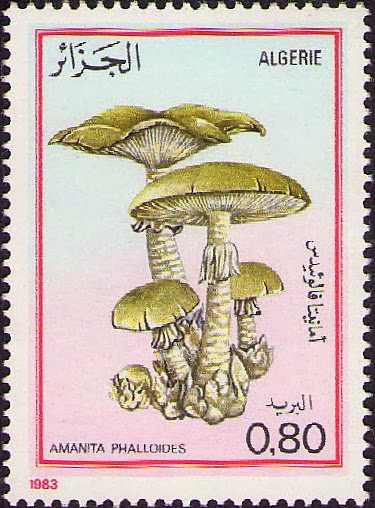
Amanita phalloides
This mushroom from the amanita family is commonly called phalloides amanita, bulbous amanita, green hemlock oronge, green oronge.
It is characterized by a fleshy cap, first spherical or ovoid, then spreading (5 to 12 cm), shiny in dry weather, a little viscous in humid weather, of variable coloring, usually olive or yellowish green, sometimes even green, yellow or whitish.
Its surface is finely striped with small brown or black fibrils radiating from the center and at the smooth margin.
Its uneven lamellae are white with a slight greenish or yellowish reflection.
Its base is slender, fleshy, full, often a little hollow in old mushrooms, whitish, swollen at the base into a more or less large bulb, membranous ring, folded down, striated.
Its membranous volva, shaped like a bag, is thick, always clearly visible and persistent.
Its white flesh with a faint odor only becomes unpleasant when the mushroom is too old.
Flavorless, but becoming slightly acrid at the end.
The white, hyaline, subglobose spores are slightly oval at the base.
The amanita phalloides grows in deciduous and tangled woods, especially under oak trees, in summer and autumn.
Poisonous, this mushroom is the most dangerous: its ingestion often causes fatal accidents.
It is characterized by a fleshy cap, first spherical or ovoid, then spreading (5 to 12 cm), shiny in dry weather, a little viscous in humid weather, of variable coloring, usually olive or yellowish green, sometimes even green, yellow or whitish.
Its surface is finely striped with small brown or black fibrils radiating from the center and at the smooth margin.
Its uneven lamellae are white with a slight greenish or yellowish reflection.
Its base is slender, fleshy, full, often a little hollow in old mushrooms, whitish, swollen at the base into a more or less large bulb, membranous ring, folded down, striated.
Its membranous volva, shaped like a bag, is thick, always clearly visible and persistent.
Its white flesh with a faint odor only becomes unpleasant when the mushroom is too old.
Flavorless, but becoming slightly acrid at the end.
The white, hyaline, subglobose spores are slightly oval at the base.
The amanita phalloides grows in deciduous and tangled woods, especially under oak trees, in summer and autumn.
Poisonous, this mushroom is the most dangerous: its ingestion often causes fatal accidents.