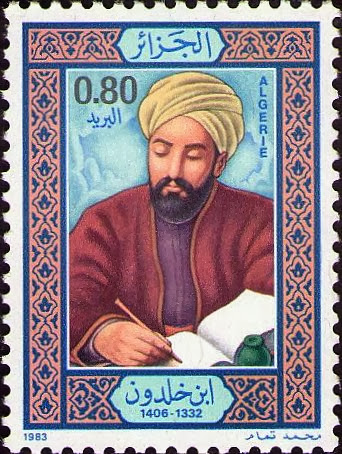
Homage to Ibn Khaldoun (1332-1406)
Although he was a remarkable statesman of his time, Abderrahman Ibn Khaldoun owed his immortality only to his masterful works as a historian and philosopher which placed him among the greatest figures of universal thought.
He was born in Tunis, on May 27, 1332, into an Andalusian family of South Arabian origin, which had immigrated to the Maghreb for several generations and was renowned for the number of its members who distinguished themselves in the fields of politics and letters. This highly cultivated environment and his excellent education would allow him to manifest his gifts as a brilliant thinker very early on.
For three quarters of a century, his life will unfold to the tumultuous rhythm of events in the Muslim West, that of the Marinids in Morocco, the Hafsids in Tunisia, the Zianids and the Hammadites in Algeria, the Nasrids in Granada and the Mamluks in Egypt coveted by the Mongol conqueror Timur Lang (Tamerlane).
Very young, Ibn Khaldoun embarked on an eventful political career following his audience with sovereigns, which took him from one of the capitals of the Maghreb to another. But this in no way interrupted his perpetual quest for knowledge and hardly prevented him from satisfying the precocious passion for writing which took hold of him in his nineteenth year when he completed in 1351 a first work dealing with the foundations of religion.
In 1375, tired of the intrigues at the origin of his wanderings across the Maghreb, he retired at the age of forty-five to Kalaât Bani Salama, in the locality of Taghzout, near Tiaret, in Algeria, far from the stale climate of courts agitated by plots and cabals, to meditate and devote himself, for four years, to the writing of his famous Muqaddima (The Prolegomena).
This speech on universal history which is the introduction to his master's Book of Considerations on the History of the Arabs, Persians and Berbers (Kitab al 'ibar fi tarikh al Arab wal Furs wal Barbar) will make him not only a historian capable of defining the methods and rules of his science, but also a precursor of sociology and a philosopher of history.
After this brief interlude devoted to study and research, Ibn Khaldoun, for a change of horizons, went to Egypt where, at the age of fifty, this time he undertook a career as a teacher and magistrate which would occupy the last quarter of his life.
Very quickly becoming the closest advisor and personal friend of the Mamluk Sultan Barquq, he actively participated in the political and intellectual life of Egypt, while continuing his activities as a writer. During a diplomatic mission to Damascus, in 1401 he had to negotiate the fate of the city with the famous Timur Lang who showed him great respect due to his consummate political qualities and his immense knowledge.
Ibn Khaldoun died in Cairo on May 17, 1406. His grave in the cemetery of the Sufis (Muslim mystics), near Bab An Nasr, has since been anonymous. By disappearing, this man of multiple dimensions left behind a work which now occupies a special place in the universal cultural heritage.
The membership of this authentic Maghreb, concurrently claimed by Algeria, which was the cradle of the blossoming of his genius, and other countries does not prevent either the Maghreb or the entire Arab nation from being rightly proud of this great thinker who, through the incontestable influence of his theories on the development and progress of several new sciences, brings honor to Arab-Muslim culture.
He was born in Tunis, on May 27, 1332, into an Andalusian family of South Arabian origin, which had immigrated to the Maghreb for several generations and was renowned for the number of its members who distinguished themselves in the fields of politics and letters. This highly cultivated environment and his excellent education would allow him to manifest his gifts as a brilliant thinker very early on.
For three quarters of a century, his life will unfold to the tumultuous rhythm of events in the Muslim West, that of the Marinids in Morocco, the Hafsids in Tunisia, the Zianids and the Hammadites in Algeria, the Nasrids in Granada and the Mamluks in Egypt coveted by the Mongol conqueror Timur Lang (Tamerlane).
Very young, Ibn Khaldoun embarked on an eventful political career following his audience with sovereigns, which took him from one of the capitals of the Maghreb to another. But this in no way interrupted his perpetual quest for knowledge and hardly prevented him from satisfying the precocious passion for writing which took hold of him in his nineteenth year when he completed in 1351 a first work dealing with the foundations of religion.
In 1375, tired of the intrigues at the origin of his wanderings across the Maghreb, he retired at the age of forty-five to Kalaât Bani Salama, in the locality of Taghzout, near Tiaret, in Algeria, far from the stale climate of courts agitated by plots and cabals, to meditate and devote himself, for four years, to the writing of his famous Muqaddima (The Prolegomena).
This speech on universal history which is the introduction to his master's Book of Considerations on the History of the Arabs, Persians and Berbers (Kitab al 'ibar fi tarikh al Arab wal Furs wal Barbar) will make him not only a historian capable of defining the methods and rules of his science, but also a precursor of sociology and a philosopher of history.
After this brief interlude devoted to study and research, Ibn Khaldoun, for a change of horizons, went to Egypt where, at the age of fifty, this time he undertook a career as a teacher and magistrate which would occupy the last quarter of his life.
Very quickly becoming the closest advisor and personal friend of the Mamluk Sultan Barquq, he actively participated in the political and intellectual life of Egypt, while continuing his activities as a writer. During a diplomatic mission to Damascus, in 1401 he had to negotiate the fate of the city with the famous Timur Lang who showed him great respect due to his consummate political qualities and his immense knowledge.
Ibn Khaldoun died in Cairo on May 17, 1406. His grave in the cemetery of the Sufis (Muslim mystics), near Bab An Nasr, has since been anonymous. By disappearing, this man of multiple dimensions left behind a work which now occupies a special place in the universal cultural heritage.
The membership of this authentic Maghreb, concurrently claimed by Algeria, which was the cradle of the blossoming of his genius, and other countries does not prevent either the Maghreb or the entire Arab nation from being rightly proud of this great thinker who, through the incontestable influence of his theories on the development and progress of several new sciences, brings honor to Arab-Muslim culture.