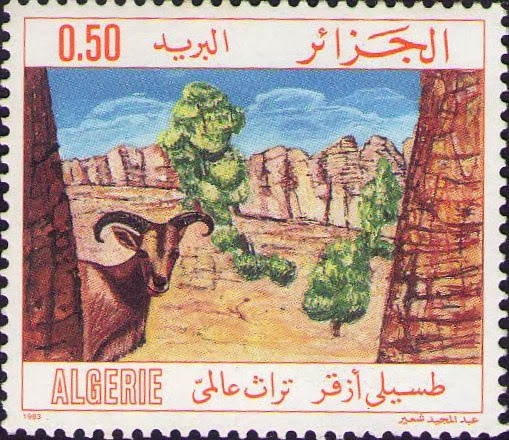
World Heritage of Tassili
Tassili has just been classified as a world heritage site in October 1982 because of the universal values it represents on both a natural and cultural level.
On this vast sandstone plateau, geological phenomena have left multiple traces. Thus, we can recognize the alternations of humid and arid episodes, the valleys of fossil wadis and the deep canyons contrasting with the current aridity.
We also discover, in a few hidden and privileged places, numerous plant and animal species, witnesses of a less dry past, which have today adapted to extreme conditions, such as the tarout (Cupressus dupreziana) or the bighorn sheep (Ammotragus lervia) or even various species of reptiles.
The plateau is home to ecosystems of great interest for science and which must be preserved at all costs. The contrast is blatant between, on the one hand, the current extremely arid climate and the fauna and flora which try to survive there and, on the other hand, the images which are so diverse and so lively and colorful painted or engraved on the rocks.
These places saw the flourishing and succession of numerous Saharan Neolithic and post-Neolithic civilizations over 5 to 6 millennia. Their traces are visible on the walls of hundreds, even thousands of rock shelters, on the cliffs, on the slabs and rock blocks along the edges of the wadis, in front of and around the shelters.
These are extraordinary paintings in which men, animals and above all magnificent herds of cattle are represented. These are impressive engravings of a whole fauna now extinct in these latitudes: elephants, giraffes, rhinoceroses, hippos. There are still quantities of fabulous objects: pottery, beads, grinding instruments, sculptures.
The Tassili contains unique testimonies of the activities of these prehistoric and protohistoric peoples, of their great mastery in the field of art, but also of the drama that played out there as throughout the Sahara: desertification, the disappearance of pastures, the drying up of the wadis and the need to adapt.
On this vast sandstone plateau, geological phenomena have left multiple traces. Thus, we can recognize the alternations of humid and arid episodes, the valleys of fossil wadis and the deep canyons contrasting with the current aridity.
We also discover, in a few hidden and privileged places, numerous plant and animal species, witnesses of a less dry past, which have today adapted to extreme conditions, such as the tarout (Cupressus dupreziana) or the bighorn sheep (Ammotragus lervia) or even various species of reptiles.
The plateau is home to ecosystems of great interest for science and which must be preserved at all costs. The contrast is blatant between, on the one hand, the current extremely arid climate and the fauna and flora which try to survive there and, on the other hand, the images which are so diverse and so lively and colorful painted or engraved on the rocks.
These places saw the flourishing and succession of numerous Saharan Neolithic and post-Neolithic civilizations over 5 to 6 millennia. Their traces are visible on the walls of hundreds, even thousands of rock shelters, on the cliffs, on the slabs and rock blocks along the edges of the wadis, in front of and around the shelters.
These are extraordinary paintings in which men, animals and above all magnificent herds of cattle are represented. These are impressive engravings of a whole fauna now extinct in these latitudes: elephants, giraffes, rhinoceroses, hippos. There are still quantities of fabulous objects: pottery, beads, grinding instruments, sculptures.
The Tassili contains unique testimonies of the activities of these prehistoric and protohistoric peoples, of their great mastery in the field of art, but also of the drama that played out there as throughout the Sahara: desertification, the disappearance of pastures, the drying up of the wadis and the need to adapt.