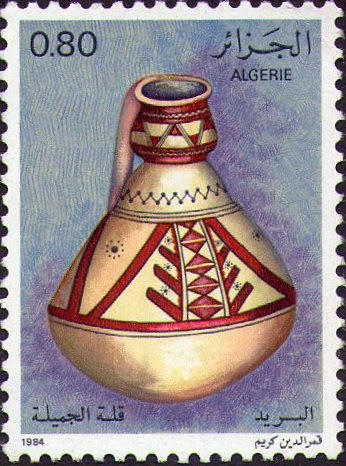
Gargoulette of Djemila
The age-old art of pottery extends throughout the mountainous massifs of the Maghreb, passing through our country where it remains rich and vibrant. Pottery was born 7,000 years ago when the cultivation of the land took over from fishing and hunting, becoming the material and social basis of Mediterranean civilizations.
Flat or hollow, pottery continues, even today, to be made with crushed clay, moistened and softened with water, without sticking to the fingers.
Since ancient times, manufacturing and shaping methods, such as the products used for decoration as well as cooking and ornamental designs, have varied very little.
The dishes are generally modeled on ancient shapes by pressing soft clay cakes followed by smoothing with a damp hand. The shaping of pottery, jars and gargoulettes is carried out in several phases, allowing the lower part to firm up, which will be completed, before drying, by clay coils that the potter stretches with one hand while, with the other hand, she holds the worked part on the outside.
To polish this pottery, pebbles, shells and smooth wood are used as polishers. Made using goat hair brushes enclosed in a ball of clay, the decoration occurs once the objects have been coated with kaolin and clay supersaturated with iron which gives a dark red color.
Manganese oxide, purplish-black brown, allows the tracing of decorations. After slow and even drying, the pottery is traditionally fired in the spring without a kiln and over an open fire.
This is how, within a small bowl delimiting the hearth, the pottery is carefully placed on a thin layer of fine wood. Everything is covered with dried dung serving as insulation, propped up with heavy wood.
Cooking lasts one or two hours depending on the size of the pieces. Amphorae, dishes, oil lamps, pots or gargoulettes, all pottery has a utilitarian function. With pure, ovoid shapes, decorated with figures or symbols of fertility and the union of opposites, pottery has preserved its symbolic aesthetic values throughout the ages.
Among the many figures, we find the arrow symbol of the male fertilizing principle, the lightning and celestial lightning announcing a fertilizing rain. Water represented by a broken line, very often associated with the image of the snake, symbolizes new birth and regeneration. The diamond for femininity and an X-shaped cross inside for virginity are also widely used motifs.
The stylized head of the ram refers to the symbol of fertility, while the serpent characterizes the resurrection of the dead and the eternal bond of the earth. The potters, with their miraculous hands, have transmitted to us, despite the vagaries of time and the danger of oblivion and from generation to generation, the inestimable treasure of the texts which were at the source of our civilizations and our writings.
In more than one way, this still-present cultural heritage deserves to be safeguarded and perpetuated.
Flat or hollow, pottery continues, even today, to be made with crushed clay, moistened and softened with water, without sticking to the fingers.
Since ancient times, manufacturing and shaping methods, such as the products used for decoration as well as cooking and ornamental designs, have varied very little.
The dishes are generally modeled on ancient shapes by pressing soft clay cakes followed by smoothing with a damp hand. The shaping of pottery, jars and gargoulettes is carried out in several phases, allowing the lower part to firm up, which will be completed, before drying, by clay coils that the potter stretches with one hand while, with the other hand, she holds the worked part on the outside.
To polish this pottery, pebbles, shells and smooth wood are used as polishers. Made using goat hair brushes enclosed in a ball of clay, the decoration occurs once the objects have been coated with kaolin and clay supersaturated with iron which gives a dark red color.
Manganese oxide, purplish-black brown, allows the tracing of decorations. After slow and even drying, the pottery is traditionally fired in the spring without a kiln and over an open fire.
This is how, within a small bowl delimiting the hearth, the pottery is carefully placed on a thin layer of fine wood. Everything is covered with dried dung serving as insulation, propped up with heavy wood.
Cooking lasts one or two hours depending on the size of the pieces. Amphorae, dishes, oil lamps, pots or gargoulettes, all pottery has a utilitarian function. With pure, ovoid shapes, decorated with figures or symbols of fertility and the union of opposites, pottery has preserved its symbolic aesthetic values throughout the ages.
Among the many figures, we find the arrow symbol of the male fertilizing principle, the lightning and celestial lightning announcing a fertilizing rain. Water represented by a broken line, very often associated with the image of the snake, symbolizes new birth and regeneration. The diamond for femininity and an X-shaped cross inside for virginity are also widely used motifs.
The stylized head of the ram refers to the symbol of fertility, while the serpent characterizes the resurrection of the dead and the eternal bond of the earth. The potters, with their miraculous hands, have transmitted to us, despite the vagaries of time and the danger of oblivion and from generation to generation, the inestimable treasure of the texts which were at the source of our civilizations and our writings.
In more than one way, this still-present cultural heritage deserves to be safeguarded and perpetuated.